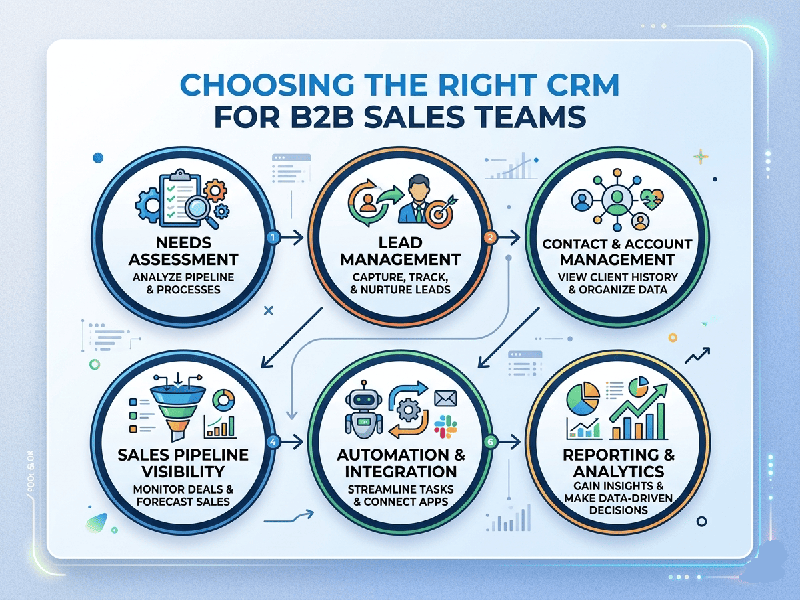
Choosing the Right CRM for B2B Sales Teams
Selecting a CRM for a B2B environment is significantly more complex than B2C because it must manage longer sales cycles, multiple stakeholders within a single account, and complex contract negotiations. In 2026, the best CRMs have moved beyond being simple "databases" to becoming "execution engines."
1. Account-Based Mapping (Relationship Intelligence)
In B2B, you aren't just selling to one person; you are
selling to a committee (Procurement, IT, Finance, Operations).
- The Requirement: Look for a CRM that supports
"Account hierarchies" and "Relationship mapping."
- The AI Edge: Modern CRMs now use AI to scan
emails and LinkedIn to automatically map who the "Decision
Maker," "Influencer," and "Gatekeeper" are within
a target company.
2. Integration with the Trade & Logistics Stack
A B2B CRM is a silo if it doesn't talk to your supply chain.
- ERP & Inventory Sync: Your sales team shouldn't
promise a delivery date without seeing real-time stock levels or
production schedules from your ERP.
- Financial Integration: Ensure the CRM connects with
your accounting software to track credit limits, outstanding EMIs for
client financing, and payment history. This prevents sales from chasing
leads that have "blocked" credit status.
3. Lead Scoring and Intent Data
Not all B2B leads are equal. "Intent data" tells
you which companies are currently researching your solution.
- Predictive Scoring: Choose a CRM that scores leads
based on firmographics (company size, industry) and behavioral signals
(e.g., they downloaded your "2026 Trade Trends" whitepaper).
- External Signals: The best CRMs integrate with
third-party data to alert your team when a prospect company receives new
funding, moves offices, or experiences a leadership change.
4. Workflow Automation for Complex Cycles
B2B sales involve many "boring" but critical tasks
that humans often forget.
- Automated Nurturing: If a prospect isn't ready to
buy for six months, the CRM should automatically drip-feed them relevant
case studies or regulatory updates.
- Document Automation: Look for built-in tools for
generating Quotes, Proforma Invoices, and NDAs that can be e-signed within
the platform.