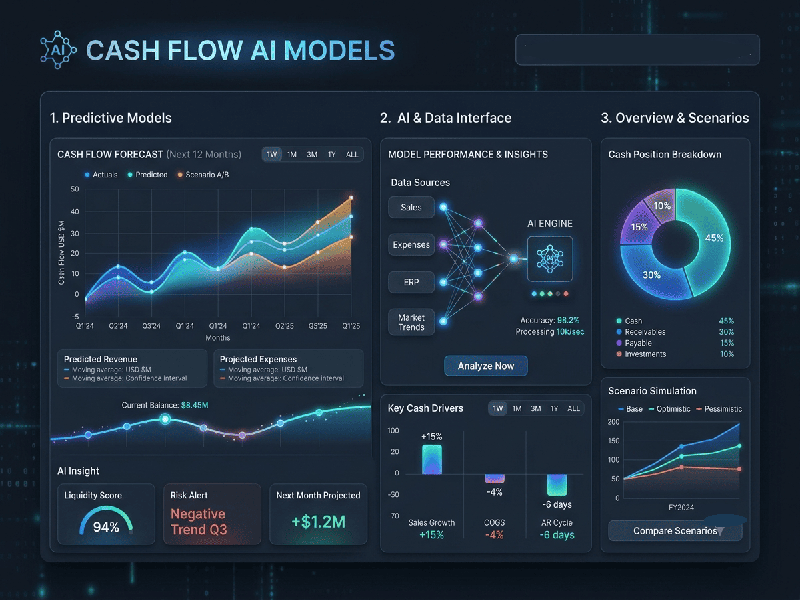
Cash Flow AI Models
Cash Flow AI Models are advanced machine learning systems designed to
automate, predict, and optimize corporate liquidity management. Unlike
traditional manual spreadsheets or rigid statistical formulas, AI cash flow
models ingest multi-source financial data, discern subtle macro and micro
payment patterns, and deliver highly accurate, real-time projections of a
company's financial health.
1. Core Capabilities of AI Cash Flow Models
A. Predictive Accounts Receivable (AR) & Customer
Payment Behavior
Instead of relying strictly on invoice due dates, AI
models analyze historical customer payment trends, seasonal buying habits,
dispute histories, and economic indicators.
They predict the exact actual date an invoice
is likely to be paid, helping treasury teams forecast incoming cash inflows
with high precision.
B. Intelligent Accounts Payable (AP) & Vendor
Spend Tracking
Models scan enterprise resource planning (ERP) systems
and procurement logs to map recurring vendor obligations, departmental burn
rates, and seasonal supply chain expenses.
They provide a granular breakdown of how capital will
leave the organization across different regions and entities over short- and
mid-term horizons.
C. Multi-Currency & Global Liquidity Optimization
For global enterprises, AI models monitor currency
exchange rate fluctuations, varying banking settlement times, and cross-border
transaction fees.
They identify the optimal timing for foreign exchange
(FX) conversions and flag potential cash shortfalls in specific regional
accounts or wallets.
2. How the AI Forecasting Engine Works
Data Consolidation & Enrichment: Automated pipelines pull real-time
data from open banking feeds, ERP systems (SAP, Oracle), payment gateways, and
corporate card platforms. The AI cleans and enriches raw transactions with
contextual metadata (such as merchant names and recurring cycles).
Machine Learning Execution: Algorithms (ranging from gradient
boosting trees to deep learning time-series models) process the consolidated
data streams to map trends that humans or static spreadsheets miss.
Continuous Variance Analysis: The system continuously compares
predicted cash flows against actual bank statements. Through self-learning
loops, it automatically recalibrates its parameters to minimize forecasting
error over time.
3. Advanced Scenario Modeling ("What-If"
Analysis)
AI cash flow systems enable finance leaders to
stress-test their liquidity under various hypothetical conditions, such as:
Sudden supply chain cost inflation or major vendor
delays.
A drop in customer demand or delayed enterprise
collections.
Aggressive expansion timelines or sudden debt
refinancing needs.
These models instantly simulate how these variables
impact working capital, cash runways, and reserve buffers.
4. Key Benefits Over Legacy Spreadsheets
Drastic Reduction in Blind Spots: Shifts finance teams from reactive
firefighting to proactive liquidity planning, lowering the risk of cash
crunches.
Higher Accuracy & Confidence: Replaces manual spreadsheet errors
with automated, data-driven accuracy rates often exceeding 90–95%.
Operational Agility: Frees up treasury and finance teams from manual data
entry, enabling them to shift focus toward high-value investment strategies and
yield optimization.