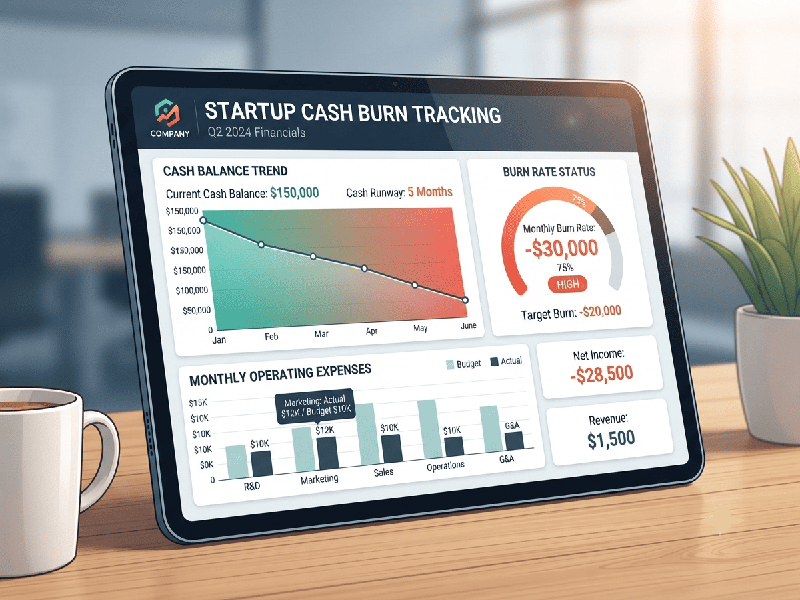
Cash Burn Tracking for Startups
For startups, Cash Burn is the rate at which a
company spends its available capital (cash reserves) before achieving positive
cash flow. Cash Burn Tracking is the critical financial process of
monitoring, analyzing, and forecasting this consumption rate.
Tracking cash burn accurately tells founders and
finance teams exactly how much financial runway they have left—measured in
months—before they need to raise additional capital, cut costs, or reach
profitability.
Core Metrics to Track
- Gross Burn Rate: The total amount of cash a
startup spends each month on operating expenses (salaries, software, rent,
marketing, etc.) without factoring in incoming revenue.
- Net Burn Rate: The actual amount of cash lost
per month. It is calculated by subtracting monthly cash inflows (revenue)
from monthly cash outflows (gross burn).
- Runway: The total number of months the
startup can survive before running out of cash.
Essential Steps
to Implement Cash Burn Tracking
1.
Centralize Financial Data: Integrate your bank accounts, credit cards, payroll systems
(e.g., Gusto), and accounting software (e.g., QuickBooks, Xero) into a single
dashboard or financial model.
2.
Categorize Expenses Accurately: Separate fixed costs (rent, SaaS subscriptions, core
salaries) from variable costs (marketing spend, contractor fees, server
scaling costs) to see where adjustments can be made quickly.
3.
Establish Weekly and Monthly Reviews: While traditional accounting looks backward monthly,
startups should review cash positions weekly to catch unexpected spikes in
spending immediately.
4.
Build Scenario-Based Forecasts: Maintain dynamic financial models that project burn rates
under different growth scenarios—such as a conservative slowdown, expected
growth, or aggressive expansion.
Best Practices for Managing and Reducing Burn
- Monitor Unit Economics: Ensure that customer
acquisition cost (CAC) and lifetime value (LTV) make sense before scaling
up marketing expenditure.
- Audit SaaS and Vendor Spools: Regularly review recurring
software subscriptions and unused cloud infrastructure to eliminate
"software creep."
- Extend Runway Proactively: If your runway drops below 6 to
9 months, begin fundraising discussions or implement cost-optimization
strategies immediately, as capital-raising cycles often take longer than
anticipated.