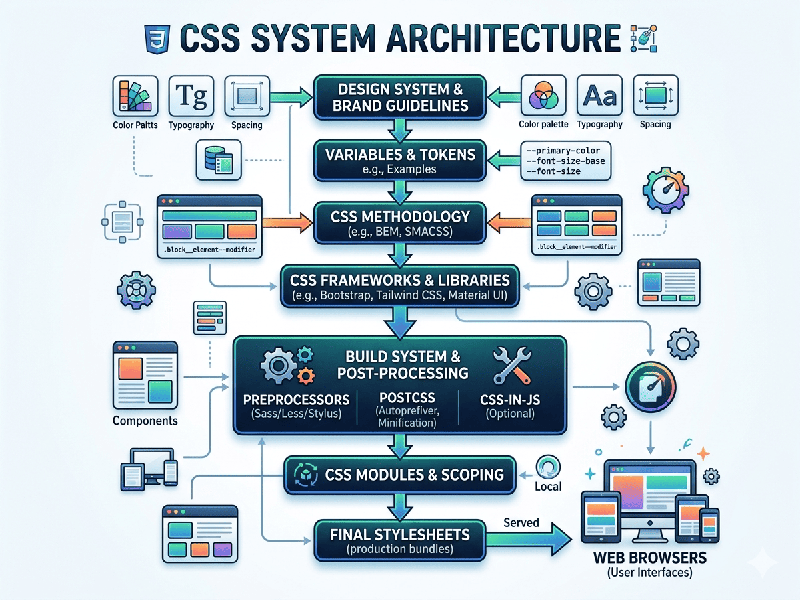
CSS System Architecture
When we talk about CSS System Architecture, we aren't
just talking about writing styles; we are talking about how we organize, scale,
and maintain those styles so they don't turn into a "global scope
nightmare."
As a project grows, CSS tends to become a tangled web of
!important tags and conflicting selectors. A solid architecture provides the
blueprint to prevent that.
1. The Core Problems Architecture Solves
- The Cascade & Specificity: Preventing "selector
wars" where you have to keep adding more specific tags to override
old styles.
- Scalability: Ensuring that adding a new
feature doesn't break three unrelated pages.
- Reusability: Creating "Lego
bricks" (components) instead of unique snowflakes for every page.
2. Popular Methodologies
These are the "philosophies" of how to structure
your CSS. Most modern teams use a mix of these.
BEM (Block, Element, Modifier)
BEM is the gold standard for naming. It makes the
relationship between HTML and CSS explicit.
- Block: Standalone entity (.card)
- Element: Parts of the block
(.card__title)
- Modifier: Versions of the block or
element (.card--featured)
OOCSS (Object-Oriented CSS)
This focuses on separating structure from skin.
- Instead of styling every button
separately, you create a base .btn class (structure) and add a .btn-blue
class (skin).
SMACSS (Scalable and Modular Architecture for CSS)
SMACSS categorizes CSS into five distinct folders:
1.
Base: Default
tags (Reset, Typography).
2.
Layout: Major
segments (Header, Footer, Grid).
3.
Module:
Reusable components (Buttons, Widgets).
4.
State: How
things look when active, hidden, or expanded.
5.
Theme: Visual
skins (Dark mode vs. Light mode).