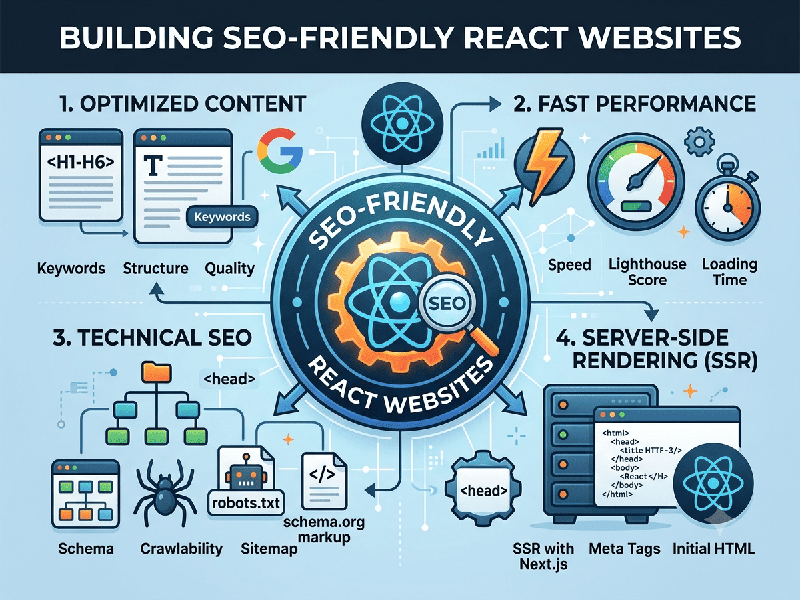
Building SEO-Friendly React Websites
Building SEO-friendly websites with React requires addressing
the fundamental challenge of Client-Side Rendering (CSR), where content
is rendered in the user's browser via JavaScript. Because search engine
crawlers may struggle to execute or index dynamic JavaScript content reliably,
the primary goal is to ensure that your site provides pre-rendered, static HTML
to those crawlers.
Recommended Implementation Steps
- Adopt a Meta-Framework: Instead of using
"vanilla" React, use frameworks like Next.js or Remix.
They handle the complexities of SSR and SSG out-of-the-box, providing the
most robust path to high SEO performance.
- Manage Metadata: Search engines rely on tags in
the <head> section (Title, Meta Description, Open Graph tags). Use
tools like next/head (in Next.js) or react-helmet to inject these
dynamically for each route.
- Use Semantic HTML: Avoid using <div> or
<span> for everything. Use semantic tags like <nav>,
<header>, <article>, and <footer> to help bots
understand the structure of your page.
- Optimize Navigation: Ensure you use standard
<a> tags for internal links. Avoid triggering navigation via onClick
events alone, as crawlers may not "click" elements to discover
new pages.
- Focus on Core Web Vitals: Google prioritizes performance.
Optimize images, implement lazy loading for non-critical components, and
minify your JavaScript bundles to ensure fast loading times (LCP, CLS, and
FID).
Technical Best Practices
1.
Avoid Hashed URLs: Do not use hash-based routing (e.g., example.com/#/about). Use standard
paths (example.com/about) so Google can treat each page as a unique entity.
2.
Sitemaps & Robots.txt: Always provide an sitemap.xml file to help search engines
discover your pages, and use robots.txt to guide them on which parts of your
site should (or should not) be indexed.
3.
Structured Data: Use Schema.org markup (JSON-LD) to provide search engines with context
about your content (e.g., product prices, ratings, or article dates), which can
lead to "rich snippets" in search results.
Key Tools
- Next.js: The gold standard for
React-based SEO.
- React Helmet: Useful for managing
<head> tags in existing Single Page Applications.
- Lighthouse: A built-in Chrome tool to audit
your site's SEO, performance, and accessibility.
- Google Search Console: Essential for monitoring how
Google sees your site and identifying indexing errors.