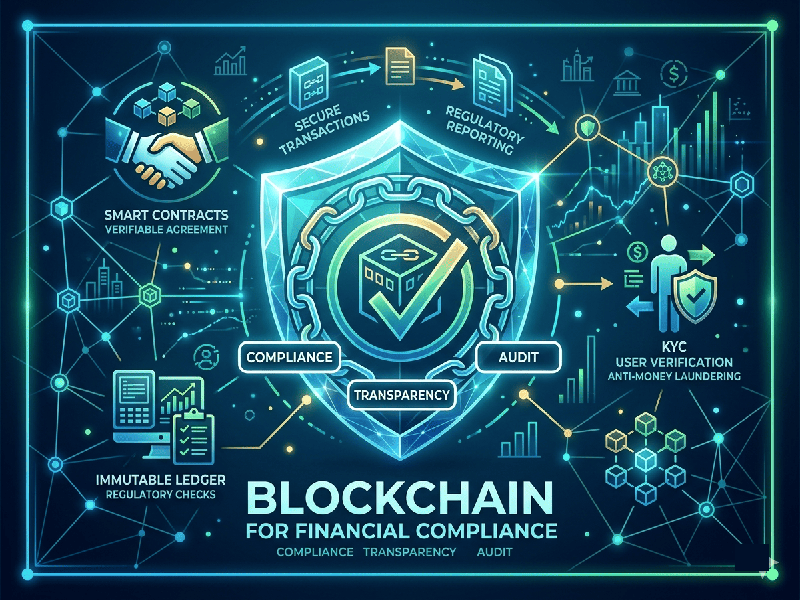
Blockchain for Financial Compliance
Blockchain has moved from a "pilot phase" to a
foundational layer for Financial Compliance. The shift is driven by the
need for real-time oversight, reducing the "compliance lag" that
traditional systems face.
1. Immutable Audit Trails
Traditional compliance relies on manual
"reconciliation," where banks compare their internal records.
Blockchain eliminates this by providing a single, tamper-proof version of the
truth.
- Sequential Logging: Every transaction is
cryptographically hashed and linked to the previous one. An auditor can
verify the entire history of an account without needing to request
physical documents from a bank.
- Prevention of Record Alteration: Because the ledger is
append-only, it is impossible for an entity to hide suspicious activity by
"editing" past transactions.
2. Shared KYC (Know Your Customer) Hubs
One of the biggest inefficiencies in finance is
"redundant KYC," where a customer must submit the same documents to
every financial institution they use.
- The "Verify Once, Use
Many" Model: When the first bank (e.g., SBI or ICICI) verifies a user's
identity, they record a cryptographic attestation on a permissioned
blockchain.
- Instant Verification: Other authorized institutions
can then verify that user instantly by checking the ledger, reducing
onboarding times from days to seconds while maintaining high security.
3. Real-Time AML & Transaction Monitoring
Anti-Money Laundering (AML) used to be a
"post-event" process. In 2026, blockchain enables pre-emptive
compliance.
- Smart Contract Guardrails: Transactions can be programmed
with "Compliance-by-Design." For example, a smart contract can
automatically block a transfer if the recipient's address is on an OFAC or
RBI sanctions list.
- Velocity Checks: Automation logic can detect
"smurfing" (breaking large sums into small ones to avoid
detection) across multiple institutions simultaneously, which is nearly
impossible in siloed legacy systems.
4. Programmable Reporting (RegTech)
Instead of banks sending monthly "Regulatory
Returns" to central banks like the RBI, the regulator can now pull data
directly from the ledger.
- Direct Regulator Access: In a consortium blockchain,
regulators like the RBI hold a "super-node" that allows them to
view anonymized transaction data in real-time.
- Automated Tax Compliance: For Indian exporters, smart
contracts can automatically calculate and withhold taxes (like GST or TDS)
at the moment of payment, ensuring 100% compliance without manual
intervention.