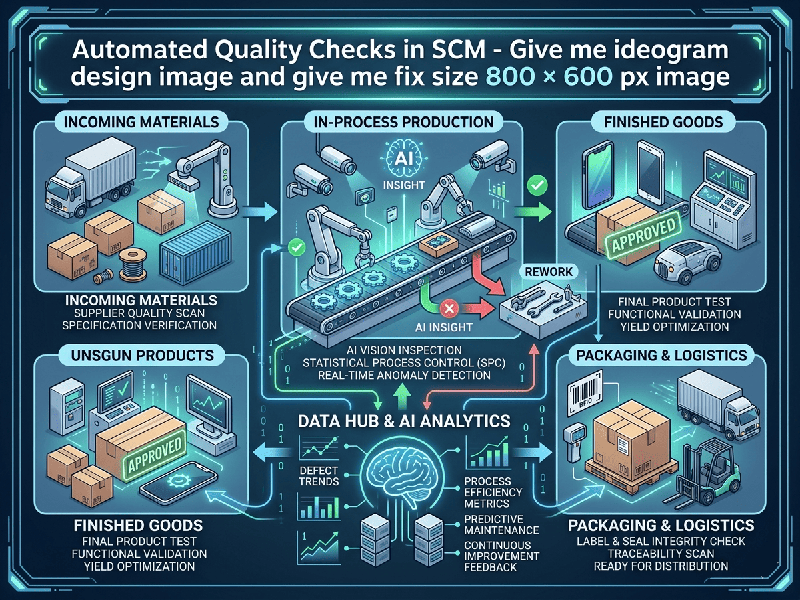
Automated Quality Checks in SCM
In Supply Chain Management (SCM), Automated Quality Checks
are the shift from reactive, manual inspection to proactive, data-driven
validation. By integrating sensors, IoT, and AI into the supply chain, you
ensure that products meet standards without slowing down the flow of goods.
1. Core Technologies for Automation
To automate quality control effectively, you must combine
hardware for data capture with software for intelligent decision-making.
- Computer Vision (AI/ML): High-resolution cameras on
conveyor belts or at goods-in/goods-out points. AI models analyze imagery
to detect surface defects, label inaccuracies, or packaging damage in
milliseconds.
- IoT & Smart Sensors:
o Environmental Monitoring: Sensors for temperature, humidity,
and shock (vibration) provide real-time alerts if sensitive goods (like organic
food or pharmaceuticals) deviate from safety protocols during transit.
o RFID & NFC: Automated tracking ensures that the
correct items are picked, reducing human errors in dispatch.
- Blockchain for Traceability: Creates an immutable ledger of
quality certifications, inspections, and origin data, ensuring compliance
and authenticity at every handoff.
3. Key Benefits for Your Supply Chain
- Reduced "Cost of Poor
Quality" (COPQ): Catching a defect at the source is exponentially cheaper than
managing returns or customer service claims.
- Real-Time Visibility: You no longer wait for a
"Quality Report" at the end of the week. You get an alert as
soon as a threshold is breached.
- Compliance Automation: For industries with strict
regulations (like food safety for Agrived Foods), automated systems
maintain a perfect, audit-ready digital log of quality inspections.
- Scalability: Manual inspections cap your
throughput. Automated checks scale linearly with your volume, allowing you
to increase order velocity without increasing headcount.
4. Best Practices for Deployment
1.
Start with High-Risk Nodes: Apply automation first where human error is most frequent
(e.g., picking and packing) or where the cost of failure is highest (e.g., cold
chain monitoring).
2.
Ensure Data Interoperability: Your automated quality tools must feed directly into your ERP
system. An error detection is useless if the system doesn't automatically
trigger a "quarantine" or "re-order" task.
3.
Define Thresholds, Not Just Alerts: Configure the system to handle common issues
autonomously. For example, if a package is below a weight threshold, the system
should automatically flag it for a physical check rather than just sending a
notification.
5. Integrating with Your Strategy
Since you are managing digital strategies for organic food
distribution, prioritize environmental sensors and batch-tracking
automation. For organic products, quality is often tied to shelf-life and
handling; therefore, integrating real-time telemetry (time-in-transit and
temperature) into your supply chain dashboard is vital for maintaining brand
integrity.