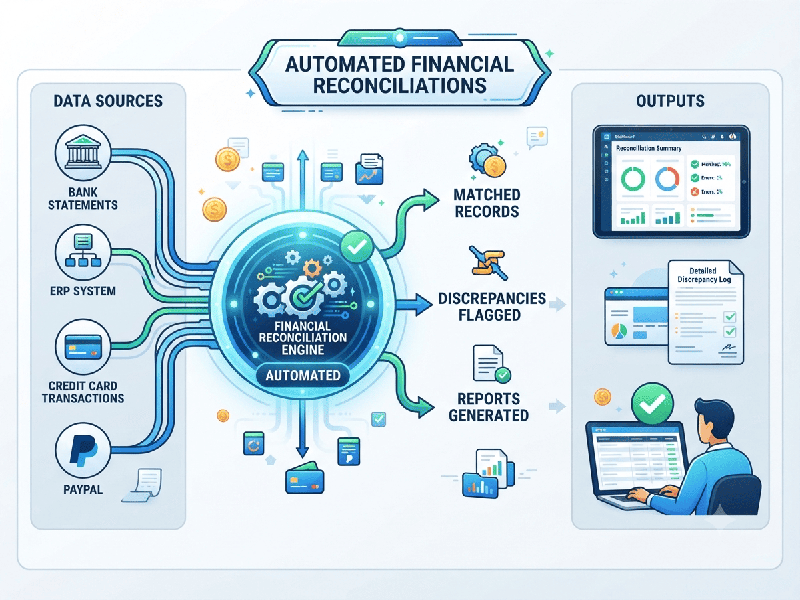
Automated Financial Reconciliations
Automated financial reconciliation is the use of
software and rules-based or AI-driven logic to compare, verify, and match
financial data across multiple sources (such as bank feeds, payment gateways,
and internal general ledgers) with little to no manual intervention.
Instead of finance teams spending hours manually
sifting through spreadsheets, automated tools continuously ingest data, align
transaction details, and highlight discrepancies in real time.
Core Benefits
- Drastic Time Savings: Eliminates tedious manual
matching, shortening month-end close cycles from days to hours.
- Higher Accuracy: Minimizes human error, broken
spreadsheet formulas, and data-entry mistakes by applying uniform matching
criteria.
- Real-Time Fraud Detection: Automatically flags anomalies,
duplicate payments, and unauthorized transactions faster than manual
reviews.
- Effortless Scalability: Easily handles rapidly growing
transaction volumes and complex multi-entity operations without requiring
proportional increases in headcount.
- Robust Compliance & Audit
Trails: Creates
a tamper-proof digital log of every user action, matching rule, and data
import, simplifying internal and external audits.
How It Works
1.
Data Ingestion:
The software pulls data automatically from disparate environments—ERP systems,
bank statements, credit card processors, and third-party vendors.
2.
Automated Matching: Configurable rules match records (e.g., matching a customer payment
entry in the ledger against an incoming bank deposit using amounts, dates, and
reference numbers).
3.
Exception Handling: Perfectly matched transactions are cleared automatically, while
unmatched items or discrepancies are isolated and flagged in an exception queue
for team review.
4.
Reporting & Insights: Dashboards generate real-time metrics on cash position,
standing liabilities, and performance trends.