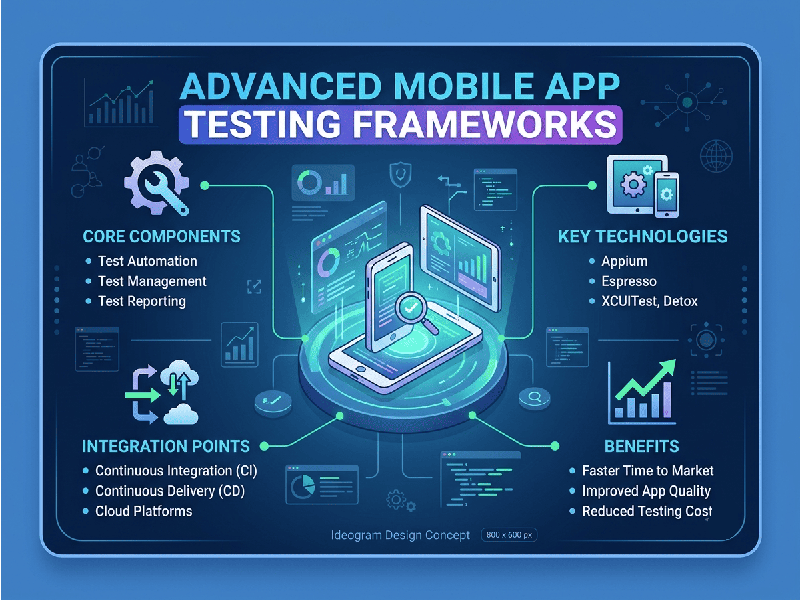
Advanced Mobile App Testing Frameworks
Advanced mobile app testing frameworks in 2026 are
categorized by their platform architecture, language support, and core testing
philosophy. Selecting the "right" framework depends heavily on your
app's technology stack (Native vs. Cross-platform) and your team’s expertise.
1. Industry Standard & Cross-Platform Frameworks
These frameworks are designed to handle both Android
and iOS, making them ideal for organizations with unified QA teams or those
building cross-platform applications.
- Appium: The undisputed industry
standard. It is open-source and uses the W3C WebDriver protocol. It is
highly flexible, supporting virtually any programming language (Java,
Python, JS, C#) and all app types (Native, Hybrid, Web).
o Best for: Large, complex projects that require
broad cross-platform coverage.
- Maestro: A newer, declarative
(YAML-based) framework that has gained rapid traction for its simplicity.
It requires no code and handles UI synchronization (auto-waiting) much
better than Appium, significantly reducing "flaky" tests.
o Best for: Teams needing rapid setup and fast
test execution for UI-heavy flows.
2. Native Ecosystem Frameworks
These tools provide the deepest integration with the
operating system, offering superior stability and performance because they run
within the application's process.
- Espresso (Android): Developed by Google and baked
into Android Studio. It automatically synchronizes with the UI thread,
making it the most stable choice for native Android apps.
- XCUITest (iOS): Apple’s native testing
framework. It is the gold standard for iOS reliability, providing full
access to native debugging and performance profiling tools.
o Best for: Teams building native apps who
prioritize high test reliability over cross-platform code reuse.
3. Tech-Stack Specific Frameworks
If your app is built on specific modern frameworks,
these tools offer better "gray-box" testing capabilities by
interacting with the framework's internal components rather than just the UI
layer.
- Detox: Primarily used for React
Native apps. It is famous for its "gray-box" testing, which
allows it to monitor the app's internal state, resulting in much faster
and more reliable asynchronous testing than black-box tools.
Strategic Considerations for 2026
- The "Hybrid"
Infrastructure Approach: Modern teams rarely rely on just one framework. A
common 2026 strategy is to use Espresso/XCUITest for critical,
low-level component tests (high stability) and Appium/Maestro for
high-level, end-to-end user journey testing (high coverage).
- Real Device Clouds: Regardless of the framework,
manual device labs are largely obsolete. Platforms like BrowserStack,
Sauce Labs, and Kobiton are now essential for accessing diverse, real
hardware environments (Android/iOS) to test sensor data (GPS, camera),
network throttling, and battery performance.
- Shift to AI-Augmented Testing: Look for tools that integrate
self-healing mechanisms for UI selectors. This dramatically reduces the
maintenance burden when UI elements are updated in your app.