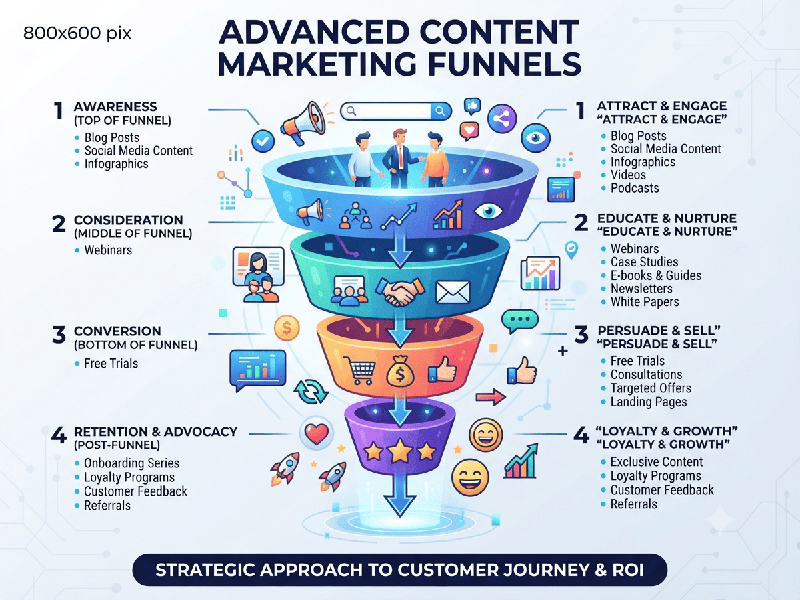
Advanced Content Marketing Funnels
An advanced content marketing funnel moves beyond the traditional linear path (TOFU → MOFU → BOFU) by creating a non-linear, multi-channel ecosystem powered by personalization, intent data, and conversion optimization.
Instead of relying solely on generic blog posts or static lead magnets, advanced funnels build retargeting loops, interactive touchpoints, and post-conversion expansion tracks.
An advanced content marketing funnel moves beyond basic top-of-funnel blog posts to create a multi-channel, behavioral-driven ecosystem. It maps highly targeted content to specific customer journey stages, leveraging automation and personalization to guide prospects seamlessly from initial discovery to long-term brand advocacy.
1. The Four-Stage Advanced Funnel Architecture
Modern funnels do not run on a linear path; they adapt to user intent across multiple touchpoints:
Top of Funnel (ToFu - Awareness): Focuses on broad industry pain points, search intent, and thought leadership. Content includes in-depth guides, industry trend reports, SEO-optimized directory listings, and short-form video assets.
Middle of Funnel (MoFu - Consideration): Targets users evaluating solutions. Content shifts toward problem-solving assets like comparison whitepapers, ROI calculators, technical documentation, and product webinars.
Bottom of Funnel (BoFu - Decision): Focuses on validation and reducing purchase friction. Content features case studies, live product demos, supplier reliability metrics, free trials, and transparent pricing matrices.
Post-Purchase (Retention & Advocacy): Protects customer lifetime value (LTV) through onboarding resources, knowledge bases, advanced user training, and referral incentives.
2. Behavioral Triggers & Dynamic Personalization
Advanced funnels replace static email blasts and generic web pages with context-aware content delivery:
Behavioral Segmentation: Track user actions—such as downloading a specific technical sheet, visiting a pricing page multiple times, or abandoning a checkout flow—to dynamically shift their journey path.
Dynamic Website Content: Use visitor data to alter landing page headlines, call-to-action (CTA) buttons, and featured case studies based on the user's industry, company size, or past interactions.
Multi-Channel Retargeting: Sync your CRM and marketing automation platforms to serve tailored social ads or search ads that match the specific content piece a user recently engaged with.
3. Best Practices for High-Performance Execution
To maximize conversion rates and operational efficiency across your content ecosystem, follow these core principles:
Align Content with CRM Data: Ensure your marketing automation tool passes deep context (lead source, key interests, content downloads) to sales teams so outreach feels relevant, not generic.
Repurpose Across Formats: Turn a single comprehensive research report or whitepaper into an infographic series, a webinar script, a dozen social media snippets, and an email nurture sequence.
Track Granular Funnel Metrics: Measure conversion rates at every micro-step (e.g., ToFu visitor to MoFu lead conversion, email click-through rates, and pipeline velocity) rather than just looking at overall traffic.