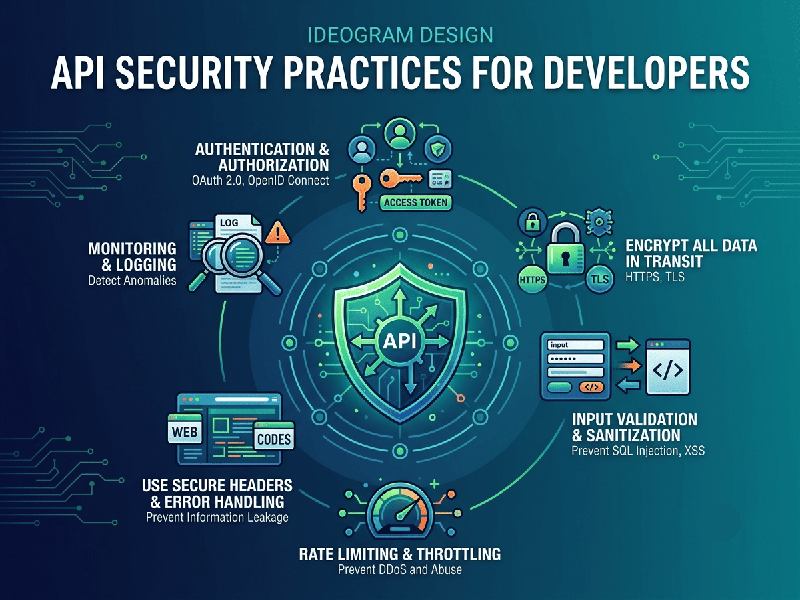
API Security Practices for Developers
Securing APIs is a critical responsibility in modern
development, as APIs are often the primary entry points for both legitimate
users and malicious actors. To protect your applications, you should adopt a
"Defense in Depth" strategy, aligning with industry standards like
the OWASP API Security Top 10.
Core Security Practices for Developers
1. Identity & Access Management (IAM)
Authentication and authorization are your first lines
of defense.
- Use Standardized Protocols: Implement OAuth 2.0 and OpenID
Connect for robust authentication and authorization. Use short-lived,
signed tokens (e.g., JWTs) and ensure they are validated properly
on every request.
- Principle of Least Privilege: Grant only the minimum
permissions necessary for an identity to perform its function. Use scopes
or Role-Based Access Control (RBAC) to restrict access to
endpoints.
- Object-Level Authorization: This is a top-tier security
concern. Never assume that a user who has access to an API endpoint has
access to every object (e.g., ID 101) requested. Always verify that the
authenticated user owns or has permission to access the specific resource.
2. Input Validation & Protection
Never trust data coming from a client.
- Strict Schema Validation: Define and enforce schemas
(e.g., via OpenAPI/Swagger). Reject requests that do not adhere to
expected types, formats, or required fields.
- Sanitization: Sanitize all incoming data to
prevent injection attacks (SQL injection, XSS, or Command Injection). Use
parameterized queries or ORMs to handle database interactions safely.
- API Gateway Integration: Use an API Gateway (e.g., Kong,
AWS API Gateway, Apigee) to centralize authentication, rate limiting, and
request validation, preventing malicious traffic from reaching your
backend services.
3. Traffic & Infrastructure Security
- Encrypt Everything: Always enforce HTTPS (TLS
1.2 or higher) for data in transit. Ensure sensitive data at rest is
encrypted using strong standards (e.g., AES-256).
- Rate Limiting & Throttling: Prevent abuse, scraping, and
Denial-of-Service (DoS) attacks by setting reasonable quotas on how many
requests a client can make within a specific window.
- Secure Infrastructure: Do not hardcode API keys or
secrets. Use environment variables or dedicated secret management services
(e.g., HashiCorp Vault, AWS Secrets Manager).
4. Observability & Lifecycle Management
- API Inventory: You cannot secure what you
don't know exists. Maintain an accurate inventory of all API endpoints,
including versioning. Deprecate and retire old ("zombie") APIs
to reduce the attack surface.
- Logging & Monitoring: Log all relevant activity
(without logging sensitive data like passwords or full tokens). Use
centralized logging and SIEM (Security Information and Event
Management) tools to detect anomalies or suspicious patterns.
Dependency Scanning: Regularly audit your third-party libraries for known vulnerabilities to protect against supply chain attacks.