API Monetization Strategies
API Monetization Strategies refer to the business models and
technical frameworks used to turn Application Programming Interfaces (APIs)
from technical cost centers into direct or indirect revenue-generating assets.
Core Direct Monetization Models
Direct monetization occurs when the API itself is
treated as the product, and consumers pay directly for access, data retrieval,
or transaction capacity.
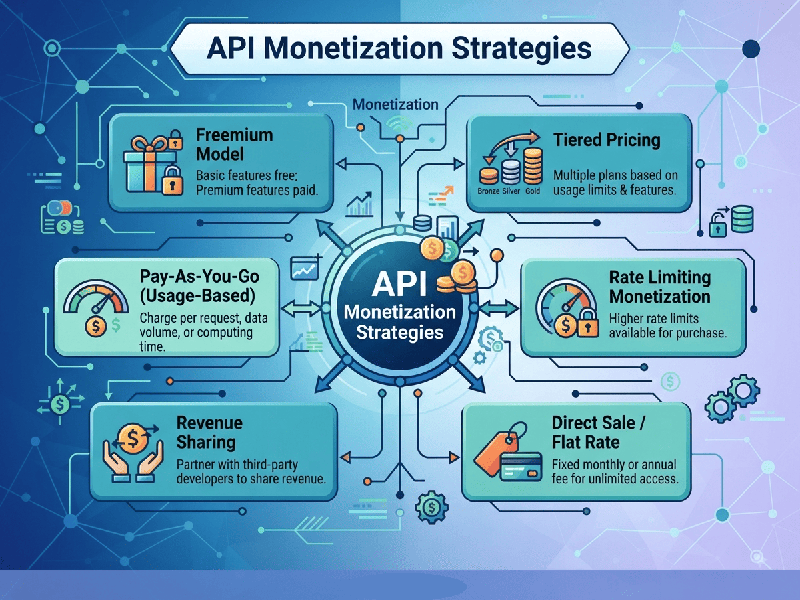
- Pay-As-You-Go
(Consumption/Metered):
o How it works: Customers are charged based on the
exact number of API calls made, data volume consumed (e.g., per MB), or compute
time utilized.
o Best for: Cloud services, data-heavy
endpoints, and communication utilities (e.g., Twilio, AWS).
- Tiered Subscriptions:
o How it works: Predictable flat monthly or annual
fees mapped to specific rate limits, feature sets, or request quotas (e.g.,
Free Tier, Pro Tier at ₹X/month, Business Tier at ₹Y/month).
o Best for: APIs providing consistent, reliable
value such as financial market feeds, weather updates, or software toolkits.
- Freemium:
o How it works: A generous free allowance for
developers to experiment, prototype, and launch. Once usage crosses a specific
threshold, consumers are automatically upsold to a paid tier.
o Best for: High-adoption developer tools and
platforms wanting minimal friction at entry (e.g., GitHub, Spotify).
- Pay-per-Transaction / Revenue
Share:
o How it works: The provider takes a cut or flat fee
for every financial transaction or successful business workflow executed
through the API.
o Best for: Payment gateways, fintech
infrastructure, and e-commerce ecosystems.
- Credit or Token-Based Pricing:
o How it works: Users purchase a bucket of credits
or tokens upfront. Different API actions consume varying amounts of credits
depending on computational complexity.
o Best for: AI model inference endpoints,
generative media APIs, and data enrichment services.
Indirect Monetization Strategies
Not all APIs carry a direct price tag. Many
enterprises use APIs as catalysts to grow core business lines indirectly:
- Driving Core Product Usage: Offering free APIs that tie
back to a larger paid software ecosystem, increasing overall customer
lock-in (e.g., opening an ecosystem for third-party extensions).
- Partner Ecosystem Expansion: Exposing backend services to
trusted partners via API to streamline onboarding, cross-selling, or
digital distribution without building custom bespoke integrations for each
client.
- Channel Partnerships &
Embedded Finance: Embedding banking, insurance, or logistics capabilities directly
into third-party apps via APIs to capture entirely new audience segments
(e.g., embedded lending APIs inside merchant apps).
Key Pillars for Implementation
Executing an API monetization strategy requires
balancing developer experience (DevEx) with rigid access control:
1.
Define the Unit of Value: Match your pricing metric directly to what the customer
perceives as valuable (e.g., data records returned, successful payments
processed, or AI tokens generated).
2.
Instrument API Gateways & Metering: Tie your API gateway (such as Tyk, Kong, or Zuplo)
directly to billing platforms like Stripe or customized ledger mechanisms to
monitor quotas, handle rate-limiting, and track real-time utilization securely.
3.
Provide a Self-Serve Developer Portal: Streamline discovery by setting up a centralized
developer portal where consumers can view interactive documentation, test in
sandboxes, generate API keys, and manage their subscription tiers seamlessly.