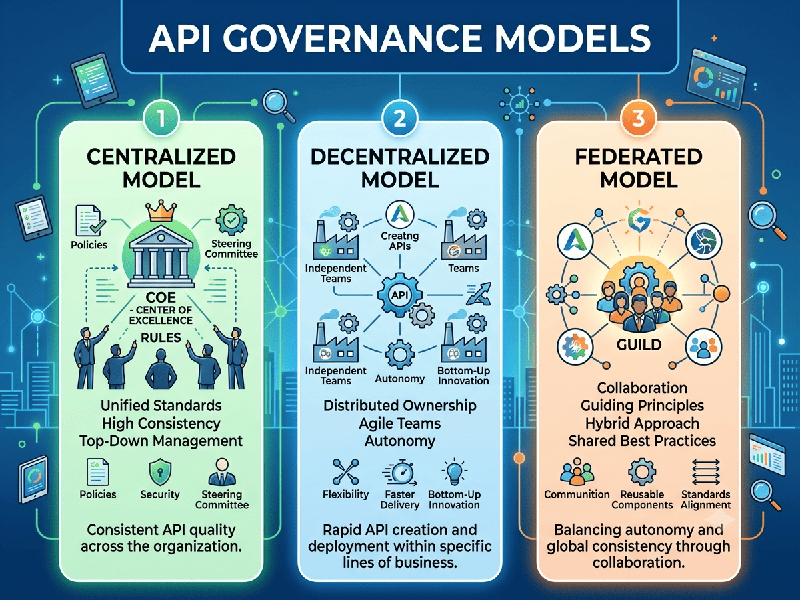
API Governance Models
API Governance Models define the organizational rules,
policies, processes, and tools that dictate how Application Programming
Interfaces (APIs) are designed, developed, secured, published, and retired
across an enterprise. A structured governance model ensures consistency, prevents
security vulnerabilities, avoids duplicative development, and maintains
compliance as systems scale.
Core Pillars of API Governance
- Design & Contract
Standardization:
Enforces uniform REST/GraphQL/gRPC naming conventions, data formatting,
error handling, and OpenAPI/Swagger specifications across all development
teams.
- Security & Access Control: Mandates zero-trust
authentication policies (OAuth 2.0, OpenID Connect, mTLS), API key
management, rate limiting, and OWASP API security vulnerability checks.
- Lifecycle & Versioning
Management:
Governs deprecation roadmaps, semantic versioning (Major.Minor.Patch),
breaking change policies, and production deployment approvals.
- Discoverability &
Reusability:
Maintains centralized API Developer Portals and registries to prevent
teams from building redundant internal endpoints.
- Observability & Operational
Compliance:
Monitors telemetry metrics (latency, error rates, throughput) and enforces
SLA compliance via centralized API Gateways.