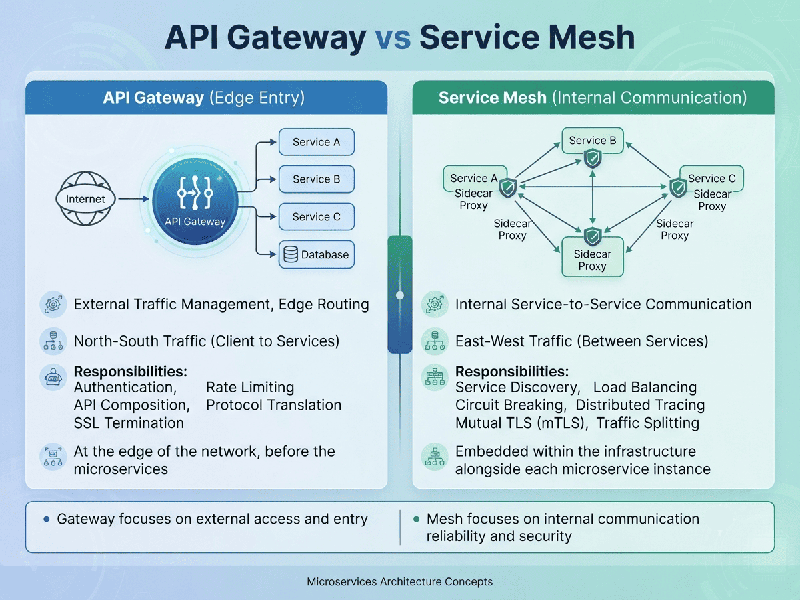
API Gateway vs Service Mesh
While both API Gateways and Service Meshes
are core infrastructure components used to manage traffic in modern
microservices architectures, they serve fundamentally different purposes,
target different traffic directions, and operate at different layers of the
network.
1. Deep Dive: API Gateway (The "Front Door")
An API Gateway is the single entry point for all
incoming requests from external clients (such as web browsers, mobile
applications, or third-party partners).
- Key Responsibilities:
o Request Routing & Translation: Directs public client calls to the
appropriate backend microservices, often transforming protocols or payload
formats.
o Edge Security & Auth: Handles user authentication (OAuth,
JWT validation), API key enforcement, and Web Application Firewall (WAF)
integration.
o Rate Limiting & Throttling: Protects backend services from abuse
or overload by restricting request volumes per user or API tier.
o Monetization & Analytics: Tracks usage metrics for billing,
developer portals, and consumer analytics.
- Popular Tools: Kong, Apigee, AWS API Gateway,
Traefik, Tyk.
2. Deep Dive: Service Mesh (The "Internal
Network Backbone")
A service mesh manages how internal microservices talk
to one another once the request is safely inside the cluster. It typically
utilizes a architecture consisting of a centralized control plane and
distributed data plane proxies (sidecars deployed alongside every
service instance).
- Key Responsibilities:
o Mutual TLS (mTLS): Automatically encrypts all
service-to-service traffic and handles cryptographic identity distribution.
o Resiliency & Traffic Control: Manages automated retries, request
timeouts, circuit breaking, and traffic splitting (for canary deployments or
A/B testing).
o Service Discovery & Load
Balancing:
Intelligently routes traffic to healthy service instances dynamically.
o Deep Telemetry: Generates detailed distributed
tracing data, service dependency graphs, and error-rate monitoring.
- Popular Tools: Istio, Linkerd, Consul Connect.
3. How They Work Together (The Coexistence Model)
In a mature cloud-native enterprise application, you
use both technologies in a unified traffic pipeline:
1.
The Entry: An
external user sends a request. It hits the API Gateway at the edge.
2.
The Validation:
The Gateway validates the user’s OAuth token, checks rate limits, inspects for
malicious payloads, and translates the request.
3.
The Handoff:
The Gateway forwards the cleaned request into the internal cluster, often
routing it directly to an Ingress Gateway managed by the Service Mesh.
4.
The Internal Journey: Once inside, the service mesh takes over—securing the transit via mTLS,
balancing loads across pods, and tracking the multi-hop trace across backend
microservices.