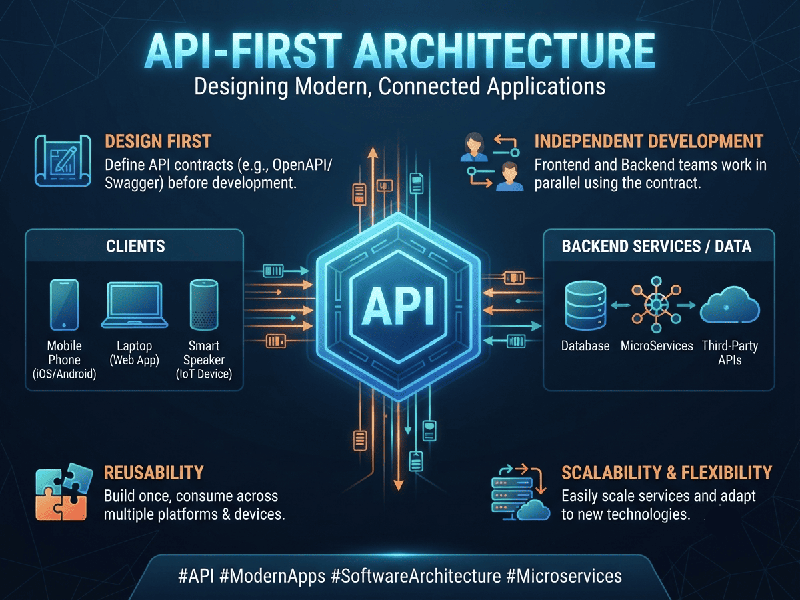
API-First Architecture in Modern Apps
API-First Architecture is a software design approach where
Application Programming Interfaces (APIs) are treated as the primary,
foundational building blocks of an application, rather than an afterthought. In
this paradigm, developers design, prototype, document, and test the API before
writing any underlying business logic or frontend user interfaces.
By prioritizing APIs from day one, organizations
ensure that applications are inherently modular, scalable, and ready to support
multiple frontends (web, mobile, IoT, wearables, and third-party integrations)
simultaneously.
Core Principles of API-First Design
1.
Design-First Approach: Using specification standards like OpenAPI (Swagger), RAML,
or API Blueprint to define the contract, endpoints, request/response payloads,
and error codes before writing code.
2.
Contract-Driven Development: Treating the API specification as a binding contract between
frontend developers, backend developers, and consumers, allowing teams to work
in parallel.
3.
Mocking and Prototyping: Generating mock servers directly from the API specification
so frontend and mobile teams can test UI flows against realistic data without
waiting for the backend to be fully implemented.
4.
Comprehensive Documentation: Treating documentation as a first-class citizen (using tools
like Redoc, Stoplight, or Swagger UI) to ensure high developer adoption and
ease of integration.
5.
Automated Testing and Governance: Enforcing security policies, schema validation, and
performance standards through automated CI/CD pipelines before deployment.
Key Benefits
- Parallel Development: Frontend and backend teams can
build and test concurrently once the API contract is finalized,
drastically reducing time-to-market.
- Omnichannel Readiness: A single backend API can power
web applications, mobile apps, smart devices, and partner integrations
without code duplication.
- Easier Maintenance and
Scalability:
Microservices architecture relies on well-defined APIs to communicate,
making it easier to scale individual components or replace legacy services
without breaking dependent systems.
- Third-Party Monetization: Clean, well-documented APIs
create opportunities to open ecosystems, allowing external developers and
partners to build extensions or integrate directly into your platform.
Essential Technology Stack & Tools
- Specification Standards: OpenAPI Specification (OAS),
AsyncAPI (for event-driven architectures), GraphQL Schema.
- Design & Mocking Platforms: Stoplight, Postman, SwaggerHub,
Redocly.
- API Gateways & Management: Kong, Apigee, AWS API Gateway,
Tyk.
- Testing & CI/CD: Postman/Newman, Pact (for
contract testing), Spectral (for linter rules).