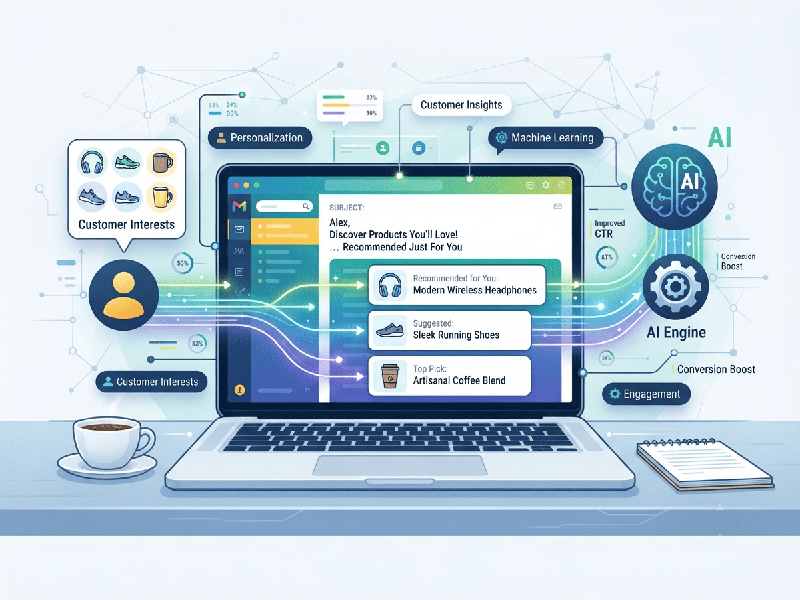
AI in Product Recommendation Emails
Artificial Intelligence has completely transformed product
recommendation emails, moving far beyond basic rule-based cross-sells
(e.g., "People who bought X also bought Y") into real-time,
predictive personalization.
Modern AI algorithms analyze browsing history, past
purchases, inventory levels, real-time engagement patterns, and lifetime value
to dynamically populate emails with products a customer is most likely to buy
at that exact moment.
1. Core Mechanisms of AI-Driven Recommendations
Unlike traditional static email blocks, AI
recommendation engines utilize several layers of machine learning:
- Collaborative Filtering: Analyzes behavioral patterns
across millions of users to find hidden correlations between disparate
products and buyer profiles.
- Content-Based Filtering: Recommends items sharing
specific attributes (color, style, category, price point) with items the
user has previously clicked on or liked.
- Contextual & Predictive
Modeling:
Factors in seasonality, local weather, replenishment cycles (e.g.,
predicting when a customer is about to run out of a consumable product),
and real-time inventory updates so out-of-stock items are never
recommended.
2. High-Impact Use Cases for Recommendation Emails
1.
Dynamic Post-Purchase Flows:
Instead of random suggestions, AI analyzes what a
customer just bought and automatically serves complementary accessories,
warranty add-ons, or the next logical upgrade tier.
2.
Predictive Replenishment Triggers:
For consumable goods (e.g., skincare, supplements,
pantry items), AI tracks average usage rates and triggers a personalized
reorder email right before the customer runs out.
3.
Smart Abandoned Cart & Browse Recoveries:
Rather than just showing the exact item left behind,
AI blends the abandoned product with complementary items or alternative options
based on the user's historical price sensitivity.
4.
Individualized Newsletters:
Instead of a single broadcast blast, AI engines
dynamically re-order and populate product blocks within a broad promotional
email so that every subscriber sees a completely unique grid tailored to their
personal preferences.
3. Key Benefits of AI Integration
- Higher Average Order Value
(AOV): By
displaying hyper-relevant cross-sells and upsells, AI-driven product
recommendations can significantly boost revenue per email.
- Reduced Opt-Outs & Fatigue: When emails consistently
feature useful, highly tailored content rather than generic spam,
subscriber fatigue decreases, keeping engagement and open rates healthy.
- Automated Scaling: Marketers no longer manually
build and segment hundreds of variations; the AI engine handles dynamic
layout generation and continuous optimization at scale.
4. Best Practices for Implementation
- Ensure Real-Time Inventory Sync: Ensure your AI recommendation
block talks directly to your warehouse management or ERP system.
Recommending an out-of-stock item completely destroys user trust.
- Maintain Fallback Logic: Always program rule-based
fallbacks (like current best-sellers or trending items) for brand-new
subscribers or anonymous leads where the AI lacks behavioral history.
- Optimize for Mobile Delivery: Over half of all emails are
opened on mobile devices. Ensure your dynamic product grids stack cleanly,
load quickly, and feature clear, prominent calls to action (CTAs).