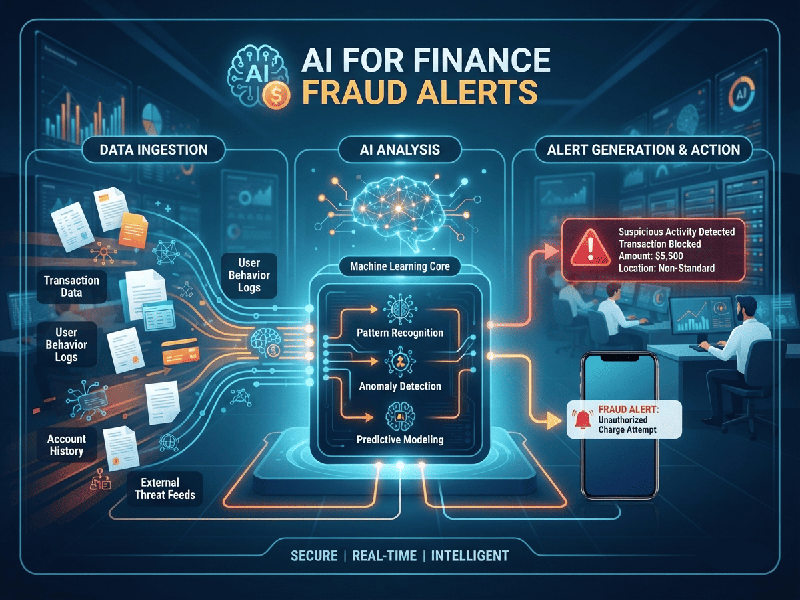
AI for Finance Fraud Alerts
AI-driven fraud alerts refer to automated security systems
powered by machine learning (ML), natural language processing, and deep
learning that detect, analyze, and flag suspicious financial transactions,
account activities, or onboarding attempts in real time.
Unlike traditional rule-based systems that rely on
rigid thresholds (e.g., flagging any transaction over a specific amount or from
an unfamiliar location), AI models evaluate thousands of subtle, interconnected
data points simultaneously to spot evolving fraud patterns with minimal false
positives.
Why Traditional Rules Fall Short
- High False Positive Rates: Static rules frequently block
legitimate transactions (causing customer friction and cart abandonment)
because they lack context.
- Inability to Catch Zero-Day
Fraud:
Criminals constantly adapt their tactics; static rules only catch known
patterns and fail against novel attack vectors.
- Manual Bottlenecks: Security teams are overwhelmed
by alert noise, making it difficult to investigate complex, multi-layered
fraud rings.
Core Pillars of AI Fraud Alert Systems
1.
Behavioral Biometrics: Analyzes how a user interacts with their device—such as
typing speed, mouse movements, swipe patterns, or device holding angles—to spot
anomalies or detect if someone else (or a bot) is remotely controlling the
session.
2.
Device & Network Intelligence: Evaluates hardware configurations, IP reputation, SIM swap
histories, and emulator usage to unmask hidden proxy networks or automated
fraud rings before a payment is processed.
3.
Real-Time Risk Scoring: Instead of a binary "allow/block" outcome, AI
assigns a dynamic risk score to every transaction or login event, allowing
systems to automatically step up authentication (e.g., triggering biometric
verification) only when risk thresholds are met.
4.
Network Graph Analysis: Maps hidden relationships between disparate accounts, phone
numbers, and physical devices to dismantle coordinated mule account networks
and synthetic identity fraud.
Key Use Cases Across the Financial Lifecycle
- Account Opening &
Onboarding:
Automatically flags synthetic identities, forged documents, and deepfake
verification attempts during digital sign-ups.
- Payment & Treasury
Operations:
Continuously monitors instant payment rails (such as wire transfers, ACH,
and real-time processing networks) to catch vendor invoice fraud,
unauthorized corporate outflows, and account takeovers.
- Scam Resilience (Authorized Push
Payments):
Detects psychological manipulation where a legitimate account holder is
tricked into transferring funds voluntarily (e.g., by spotting hesitation
signals, active phone calls during high-risk transfers, or
uncharacteristic payment destinations).
Best Practices for Deployment
- Ensure Explainability: Select AI architectures that
provide clear rationale codes for every alert rather than a "black
box" output, ensuring compliance with regulatory and audit
requirements.
- Establish Continuous Feedback
Loops: Ensure
that the decisions made by human fraud analysts are fed directly back into
the model to refine scoring accuracy over time.