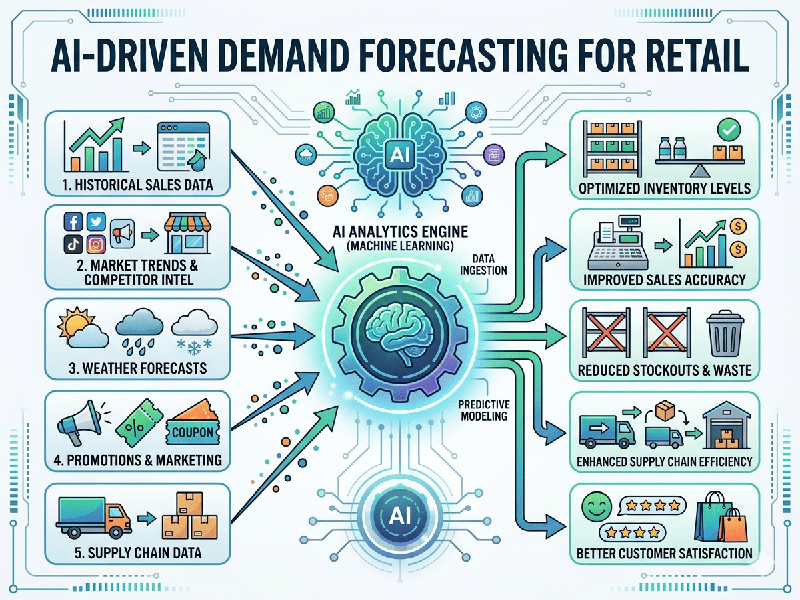
AI-Driven Demand Forecasting for Retail
AI-driven demand forecasting represents a shift from
traditional "look-back" statistical models to predictive, real-time
systems. While traditional methods (like moving averages) rely almost
exclusively on internal historical sales, AI models ingest thousands of
external variables to predict what customers will want before they even know it
themselves.
Key Components of an AI Forecasting System
To build an accurate forecast, AI models process data through
a multi-layered pipeline:
1. Multi-Source Data Ingestion
AI doesn't just look at what you sold; it looks at why you
sold it.
- Internal Data: POS transactions, inventory
levels, and promotion calendars.
- External Data: Global supply chain delays,
local weather patterns, and even social media sentiment (e.g., a TikTok
trend causing a sudden spike in a specific SKU).
2. Advanced Machine Learning Models
Retailers typically use a mix of these architectures:
- Recurrent Neural Networks (RNNs)
& LSTMs:
Specifically designed for time-series data to remember long-term seasonal
patterns.
- Gradient Boosting
(XGBoost/LightGBM): Excellent for handling tabular data and identifying which features
(like a 10% discount) have the most impact on sales.
- Ensemble Modeling: Combining multiple models to
reduce "noise" and improve reliability.
Business Benefits in 2026
- Reduction in "Dead
Stock": By
identifying when a trend is fading, AI prevents retailers from
over-ordering items that will eventually need aggressive markdowns.
- Hyper-Local Optimization: AI can forecast demand
differently for two stores in the same city based on hyper-local factors
like proximity to a stadium or a school.
- Dynamic Reorder Points: Instead of a static
"reorder when stock hits 10," the system adjusts thresholds
based on predicted spikes, such as an upcoming holiday weekend.
- Labor Optimization: Accurate demand forecasts allow
store managers to schedule the right number of staff for expected foot
traffic, reducing overhead costs.