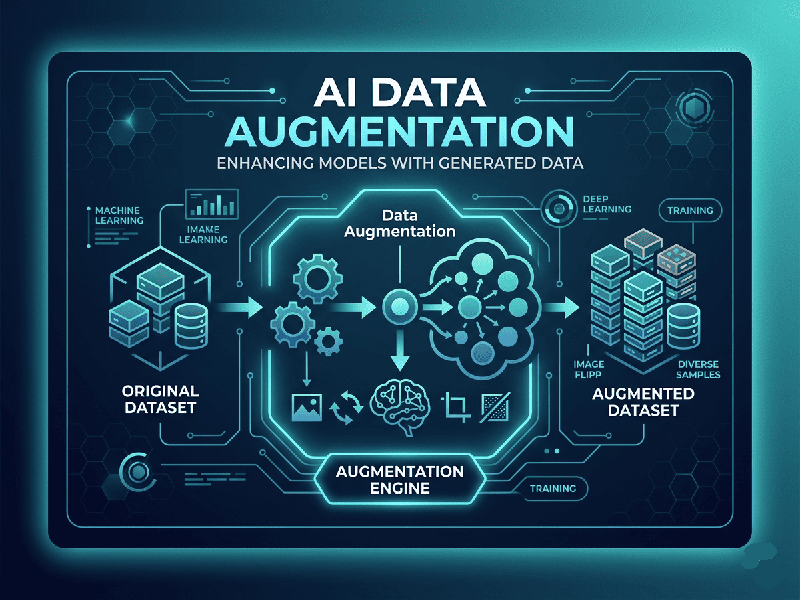
AI Data Augmentation
AI Data Augmentation is a technique used in machine learning to increase the amount and diversity of data without collecting new raw samples. Instead of finding more data, it involves creating "synthetic" variations of existing data. This is crucial because deep learning models require vast amounts of data to generalize well and avoid overfitting (where a model memorizes the training data but fails on new, unseen data).
Core Methods of Data Augmentation
Data augmentation strategies vary significantly depending on
the type of data being processed:
1. Computer Vision (Image Data)
This is the most common application. By slightly altering an
image, you teach the model that the object remains the same regardless of its
orientation or lighting.
- Geometric Transformations: Flipping (horizontal/vertical),
rotation, cropping, and scaling.
- Color Space Transformations: Adjusting brightness, contrast,
saturation, or adding "noise" to the image.
- Kernel Filters: Sharpening or blurring images
to make the model more resilient to low-quality inputs.
- Random Erasing: Deleting a small random part of
the image to force the model to look at the whole object rather than one
specific feature.
2. Natural Language Processing (Text Data)
Augmenting text is more complex because changing a single
word can alter the entire meaning (semantics).
- Synonym Replacement: Replacing random words with
their synonyms using databases like WordNet.
- Back Translation: Translating a sentence into
another language (e.g., English to French) and then back to the original
language to get a slightly rephrased version.
- Random Insertion/Deletion: Adding or removing non-critical
words to make the model focus on core keywords.
3. Audio Data
Used extensively in speech recognition and music AI.
- Noise Injection: Adding background white noise.
- Time Shifting: Moving the audio forward or
backward.
- Pitch Shifting: Changing the pitch of the audio without affecting the speed.