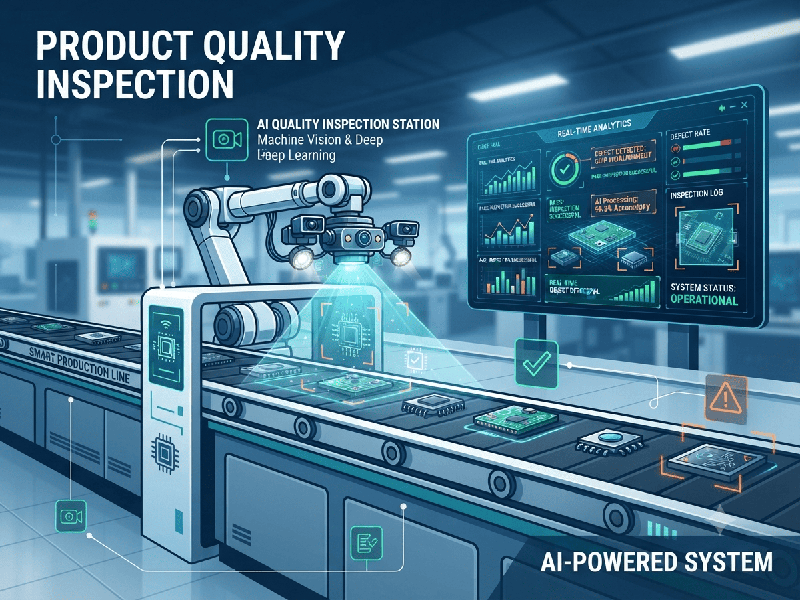
AI-Based Product Quality Inspection
AI-Based Product Quality Inspection leverages computer vision, deep
learning, and IoT sensors to automate the defect detection process on
manufacturing lines. Traditional quality control relies heavily on manual
visual inspection, which is slow, subjective, and prone to human fatigue.
AI-powered systems inspect items at high-speed lines
in real time, identifying microscopic cracks, misalignments, color
inconsistencies, or surface blemishes with a level of precision and consistency
that far exceeds human capability.
Core Technologies Powering AI Quality Control
- Computer Vision & Deep
Learning Models:
Convolutional Neural Networks (CNNs) and transformer models are trained on
thousands of images of both "good" and "defective"
products to learn what constitutes an acceptable item.
- Edge Computing: Because manufacturing lines
require instant decision-making (e.g., rejecting a defective item on a
fast-moving conveyor belt), AI inference runs locally on high-performance
edge devices rather than relying on cloud round-trips.
- Advanced Sensor Fusion: Combines standard RGB cameras
with specialized imaging such as infrared, thermal, 3D laser profiling,
and X-ray imaging to detect internal flaws or surface anomalies invisible
to the naked eye.
Key Use Cases Across Industries
1.
Electronics Manufacturing: Inspecting microscopic solder joints, PCB (Printed Circuit
Board) defects, and missing components on high-density circuit boards.
2.
Automotive & Heavy Industry: Detecting surface scratches, welding flaws, stamping
defects, and structural irregularities in metal parts.
3.
Food, Beverage, and Pharmaceuticals: Scanning for packaging seal integrity, label
misalignments, correct fill levels, and contamination or bruising in raw
produce.
4.
Textiles & Apparel: Identifying fabric weaving errors, dye inconsistencies, and
stitching flaws across continuous rolls of material.
Major Benefits of Implementation
- Drastic Reduction in False
Positives & Scrap: High-precision AI minimizes the "over-kill" rate, where
good products are mistakenly rejected by rigid, traditional automated
sensors.
- 2/7 Continuous Operation: AI systems do not experience
fatigue, maintaining identical inspection standards across multi-day
shifts.
- Predictive Quality Analytics: Rather than just catching bad
parts at the end of the line, AI analytics track defect trends over time
to flag root causes (e.g., a specific machine tool wearing down) before
it ruins an entire production batch.
Implementation Challenges & Best Practices
- The "Cold Start" Data
Problem:
Training an AI model requires thousands of images of defects, which
are rare in a well-run factory. Best Practice: Use synthetic data
generation or unsupervised anomaly detection models (which only need to
learn what a "good" product looks like).
Lighting and Environmental Control: Dust, vibration, and shifting factory lighting can skew computer vision accuracy. Best Practice: Invest heavily in robust, enclosed optical chambers with stable, specialized industrial lighting setups.