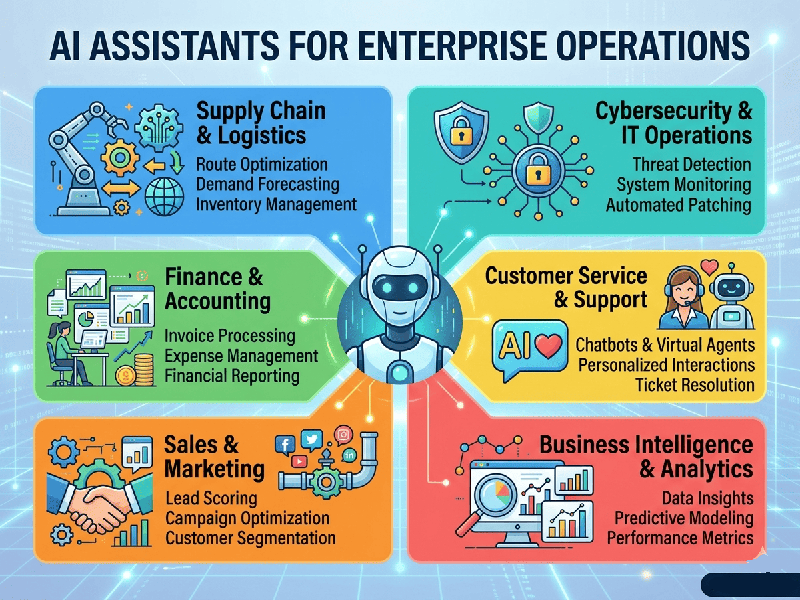
AI Assistants for Enterprise Operations
The landscape for enterprise AI assistants has
shifted from simple "chatbots" to agentic AI—systems capable
of autonomous reasoning, multi-step execution, and deep integration with core
business platforms. Organizations are no longer just experimenting; they are
deploying these agents to perform end-to-end workflows that were previously
manual.
1. Key Trends in 2026 Enterprise AI
- From Productivity to Autonomy: The primary differentiator
today is "agentic capability." Modern assistants don't just
draft documents; they initiate and complete workflows (e.g., procurement
reconciliation, IT ticket resolution) with minimal human intervention.
- Purpose-Built vs. Embedded: While businesses often start
with platforms they already use (Microsoft Copilot, Google Gemini for
Workspace, Salesforce Agentforce, SAP Joule), many are finding that purpose-built,
specialized agents (like Moveworks for IT/HR or Sana for Finance)
often outperform embedded options in specific, high-complexity tasks.
- Orchestration & Multi-Agent
Systems:
Enterprises are moving toward "multi-agent orchestration," where
a network of specialized agents interacts to handle complex,
cross-departmental processes (e.g., onboarding an employee involves
Finance, IT, and HR agents working in concert).
2. Evaluating Your Next Move
If you are currently evaluating AI platforms for your
enterprise, consider these three pillars:
- Security & Governance: As these agents become
"actors" in your system, they are susceptible to new risks like
prompt injection. Prioritize vendors that offer robust Zero-Copy
Architecture (data doesn't leave your perimeter) and deep Role-Based
Access Control (RBAC).
- Integration Depth: A great agent is only as
effective as the data it can access. Look for platforms that support
"connective tissue" between legacy systems and modern cloud
infrastructure.
- Agentic Frameworks: If you have unique, internal
workflows, consider platforms that allow for "low-code" agent
building (e.g., Activepieces, Microsoft Copilot Studio) to create custom
agents tailored to your specific business rules.
3. Implementation Best Practices
1.
Stop "Pilot Purgatory": Move beyond small tests by aligning AI initiatives with
specific, measurable KPIs like Days Sales Outstanding (DSO) reduction or
FTE hours saved.
2.
Human-in-the-Loop (HITL): For high-stakes operations (like finance or procurement),
configure agents with mandatory approval steps. Treat "human
approval" as an integrated part of the workflow, not an afterthought.
3.
Governance First: Establish an "instruction hierarchy" for your agents. If an AI
can "act," it can be abused. Ensure your AI platform provides clear
audit logs for every decision an agent makes.