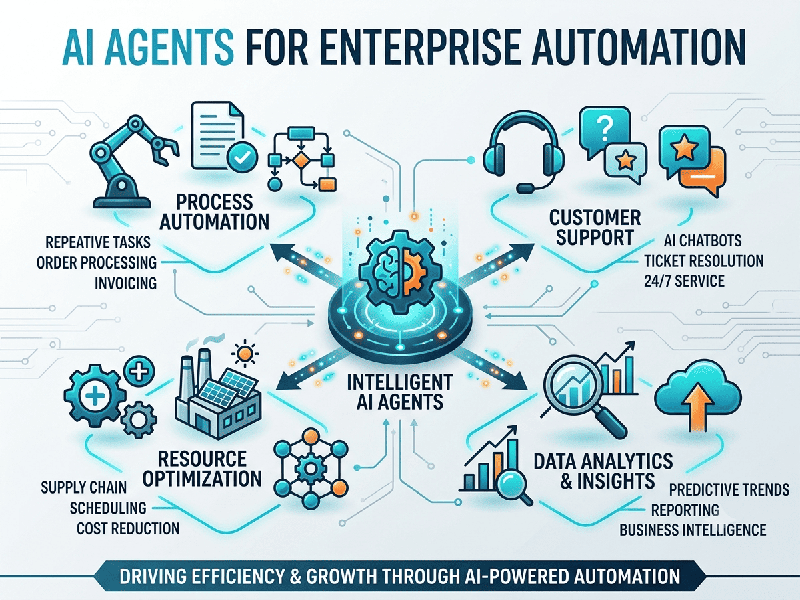
AI Agents for Enterprise Automation
Unlike traditional rule-based automation scripts or
reactive chat bots, AI agents are autonomous software systems powered by
Large Language Models (LLMs) that can reason, plan, and execute multi-step
workflows to achieve business goals. They act as the "connective
tissue" across enterprise tech stacks, interacting with CRMs, ERPs, and
databases with minimal human intervention.
Key Capabilities & Core Architecture
- Autonomous Reasoning &
Planning: Breaks
down complex high-level objectives into sequential steps, adapting
dynamically when unexpected conditions arise.
- Tool Integration: Connects directly via APIs to
existing enterprise applications (e.g., Salesforce, SAP, Jira) to read
records, trigger actions, and update statuses.
- Contextual Memory &
Guardrails:
Retains short- and long-term context across workflows while operating
under strict compliance, data privacy, and security constraints.
High-Impact Enterprise Use Cases
- Customer Support & Service
Management:
Classifies tickets, queries knowledge bases, executes authorized account
actions, and routes complex problems to human reps.
- Finance & Procurement: Automates invoice matching,
anomaly and fraud detection, financial forecasting, and supplier payment
recommendations.
- Supply Chain & Logistics: Monitors inventory levels,
optimizes shipping routes, and predicts production disruptions or
equipment maintenance needs.
Best Practices for Deployment
1.
Start with High-Volume Bottlenecks: Target repetitive, manual workflows like document
classification, employee onboarding, or ticket routing.
2.
Define Strict Autonomy Boundaries: Clearly outline which tasks the agent executes independently
versus those requiring human-in-the-loop sign-off (e.g., financial payouts).
3.
Ensure Data Readiness: Clean and organize internal data repositories, setting
proper access permissions and security controls before connecting agents.