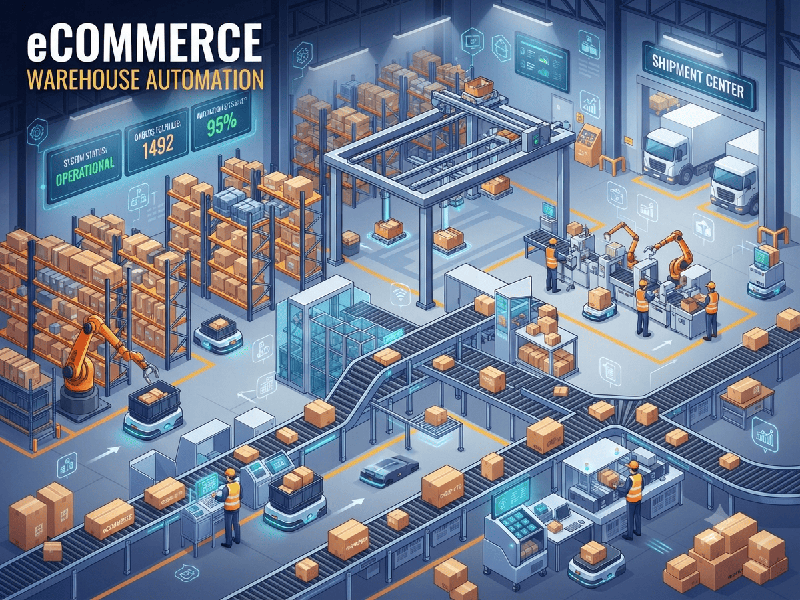
eCommerce Warehouse Automation
eCommerce Warehouse Automation refers to the use of advanced
technologies, robotics, and intelligent software to automate repetitive manual
tasks in the fulfillment process. As order volumes grow and delivery speed
expectations (next-day/same-day) rise, automation is no longer just a luxury—it
is essential for operational scalability and cost efficiency.
Key Areas of Warehouse Automation
Automation is typically deployed across these critical
stages of the fulfillment lifecycle:
- Goods-to-Person (GTP) Systems: Instead of workers walking
through aisles to pick items, robots (AMRs or AGVs) bring the shelves or
bins directly to the worker at a designated picking station.
- Automated Storage and Retrieval
Systems (AS/RS):
High-density systems that use cranes or shuttles to store and retrieve
inventory automatically, maximizing vertical warehouse space.
- Pick-by-Light & Voice
Picking: Systems
that use LED lights on shelves or voice-guided headsets to direct human
pickers to the exact location of an item, reducing search time and human
error.
- Automated Packaging &
Labeling:
Machines that calculate the exact box size needed, seal the package, and
apply shipping labels automatically based on weight and destination.
- Autonomous Mobile Robots (AMRs): Flexible robots that navigate
the warehouse floor to transport goods from receiving to storage or from
picking stations to packing areas.
Strategic Benefits
- Increased Throughput: Automation allows warehouses to
operate at higher speeds for 24/7, enabling faster order processing and
tighter shipping windows.
- Improved Accuracy: Automated systems (like
scanners and weight checkers) significantly reduce picking and packing
errors, directly lowering the cost of returns.
- Space Optimization: Through high-density storage
and vertical integration, businesses can store more inventory in a smaller
physical footprint, which is critical in high-cost real estate markets.
- Labor Efficiency: By automating "dull,
dirty, and dangerous" tasks, human workers can be redeployed to
higher-value roles, such as quality control, exception handling, and
management.
The Role of Software (The "Brain")
Hardware is ineffective without a sophisticated
digital layer. Effective automation requires:
- Warehouse Management System
(WMS): The
central platform that tracks inventory, manages orders, and coordinates
the flow of goods.
- Warehouse Execution System
(WES): The
software that bridges the gap between the WMS and the warehouse hardware
(robots, conveyors, sorters), ensuring real-time coordination.
- Predictive Analytics: Using AI to forecast demand,
helping warehouse managers pre-position popular stock closer to the
shipping docks before orders even arrive.
Challenges to Consider
1.
High Upfront Capital: Automating a facility requires significant initial investment. Companies
often start with "modular" automation that can be scaled as business
grows.
2.
System Integration: Ensuring that legacy ERP systems communicate seamlessly with new
robotics software can be technically demanding.
3.
Maintenance & Downtime: Automated systems require specialized technical staff or
vendor support contracts to ensure that a technical glitch does not halt the
entire shipping pipeline.
Best Practices for Implementation
- Start with Data: Analyze your current order
patterns. Identify the most labor-intensive tasks—such as small-item
picking or long-distance travel—and prioritize automating those first.
- Scalable Design: Choose modular hardware that
can be added to your facility over time rather than a
"rip-and-replace" approach.
- Focus on Ergonomics: Ensure that automation stations
are designed for human comfort, reducing fatigue and turnover.