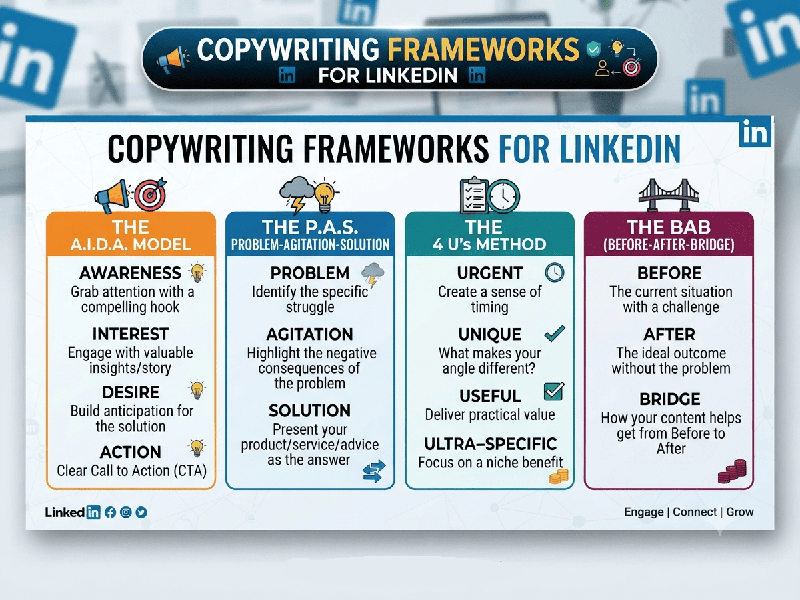
Copywriting Frameworks for LinkedIn
To stand out in the crowded LinkedIn feed, your
writing needs to be structured, scannable, and value-driven. LinkedIn's
algorithm rewards "dwell time"—the amount of time a user spends
reading and engaging with your post.
1. The PAS Framework (Problem-Agitation-Solution)
This is the gold standard for B2B copywriting because
it builds an immediate connection by addressing a pain point.
- Problem: Identify a specific challenge
your target audience faces.
- Agitation: Deepen the pain by explaining
why this problem is costing them time, money, or energy.
- Solution: Introduce your product,
service, or insight as the remedy.
- Why it works: It creates an emotional hook
before introducing the "sell."
2. The AIDA Framework
(Attention-Interest-Desire-Action)
This classic marketing funnel works perfectly for
shorter, punchy LinkedIn posts that aim to drive traffic or leads.
- Attention: A strong "hook" (the
first 1–2 lines) that stops the scroll.
- Interest: Provide a surprising fact, a
counter-intuitive observation, or a relatable story.
- Desire: Explain why the reader needs
to care—show, don’t just tell, the benefits of your perspective.
- Action: A clear, singular
Call-to-Action (CTA) (e.g., "Check the comments for the link,"
"Follow me for more," or "What’s your take?").
3. The BAB Framework (Before-After-Bridge)
This is ideal for showcasing results, case studies, or
the success of a business transformation.
- Before: Describe the current,
less-than-ideal state (e.g., struggling with supply chain inefficiencies).
- After: Describe the dream state (e.g.,
a fully automated, transparent workflow).
- Bridge: Explain the specific actions or
tools taken to get from "Before" to "After."
- Why it works: It provides a roadmap that
makes your expertise feel achievable.
4. The "Listicle" / Value-Stack Framework
LinkedIn users love high-utility content that they can
save for later. This framework is best for long-form educational posts.
- The Hook: A bold promise (e.g., "5
tools to fix your ERP performance").
- The Stack: A numbered list where each
point provides one clear, actionable tip.
- The Takeaway: A concluding thought or a
summary that encourages people to save the post.
- Why it works: It is highly scannable and has
the highest rate of "Bookmark/Save" engagement, which the
algorithm loves.
Tips for LinkedIn-Specific Formatting
- The "Hook" is
everything: The
first two lines are visible before the "see more" button. If
they don't capture attention, the rest of your work remains unread.
- White Space: Break your paragraphs into 1–2
sentences max. A wall of text is the enemy of mobile users.
- Use Visuals Strategically: Whether it's an ideogram-style
infographic (800x600px is ideal) or a simple chart, ensure it complements
the text.
- The ₹ (Rupee) Context: When discussing financial or
cost-saving tips, ensure any financial icons utilize the ₹ symbol
to maintain local market relevance for your Indian audience.
- Authentic Engagement: End with a
"low-friction" question. Instead of "What do you
think?", try "Which of these 3 steps would you implement
first?"