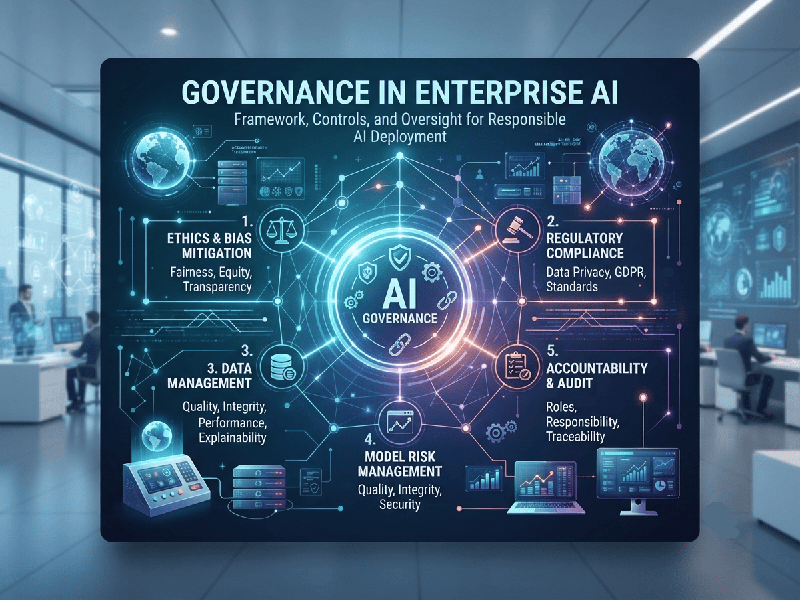
Governance in Enterprise AI
Enterprise AI governance is a structured framework of
processes, standards, and guardrails designed to manage the approval,
deployment, monitoring, and evolution of AI systems across an organization. It
serves as the "rules of the road" that ensure AI initiatives are
safe, ethical, compliant, and aligned with broader business objectives.
Key Components of AI Governance
A robust governance framework typically includes the
following core elements:
- Strategy & Oversight: Defines leadership structures,
decision-making rights, and accountability. This ensures that AI projects
have clear ownership and align with organizational goals.
- Risk Management: Identifies and mitigates risks
such as algorithmic bias, security vulnerabilities, and unintended
outcomes throughout the AI lifecycle.
- Data Governance: Since AI is data-dependent,
this component ensures data quality, security, privacy, and clear lineage
(tracking the source and transformation of data).
- Model Governance & Lifecycle
Management:
Standardizes how models are developed, validated, tested, versioned, and
monitored to ensure they remain reliable and performant over time.
- Ethics & Responsible AI: Establishes principles—such as
fairness, transparency, and human oversight—to reduce harm and ensure
outcomes align with societal values.
- Compliance & Legal Controls: Keeps the organization in line
with regional regulations (e.g., EU AI Act, GDPR) and industry-specific
mandates through audit trails and documentation.
- Culture, Training & Change
Management:
Promotes AI literacy among employees to ensure that ethical considerations
and risk awareness are embedded in daily decision-making.
Why It Is Important
- Trust & Reliability: Establishes confidence among
customers, stakeholders, and regulators by proving that AI systems are
predictable and well-managed.
- Operational Efficiency: Provides a clear, repeatable
path for deploying AI, which reduces friction and prevents "shadow
AI" (unauthorized use of tools).
- Risk Mitigation: Prevents reputational damage,
legal liabilities, and financial loss caused by biased or faulty AI
decisions.
- Innovation at Scale: By creating a secure, governed
environment, organizations can experiment and innovate faster without the
fear of uncontrolled risks.
Best Practices for Implementation
1.
Define Scope & Priorities: Do not attempt to govern everything at once. Identify which
AI models are in use, their risk levels, and which business units they impact.
2.
Assemble a Cross-Functional Team: Governance shouldn't sit solely with IT. Involve legal,
compliance, risk, HR, and business unit leaders to ensure diverse perspectives.
3.
Establish an AI Inventory: Create a centralized register of all AI systems (in-house,
vendor-embedded, and pilot programs) to eliminate blind spots.
4.
Operationalize with Tooling: Move governance out of spreadsheets. Use platforms that
allow for automated approval workflows, risk tracking, and real-time
monitoring.
5.
Foster a Culture of Responsibility: Treat AI literacy as a mandatory skill. Create clear
channels for employees to report concerns without fear.