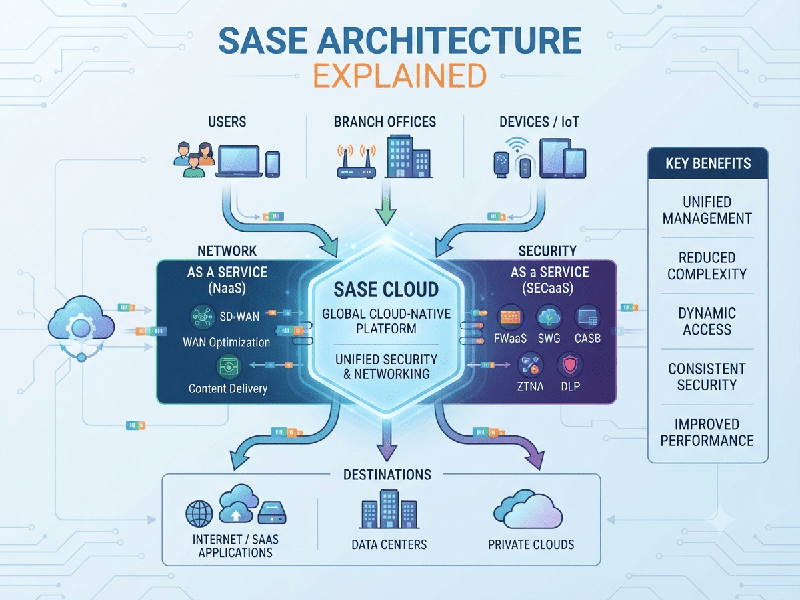
SASE Architecture Explained
Secure Access Service Edge (SASE) is a cloud-native architectural
model that converges wide-area networking (WAN) and security services into a
single, unified, cloud-delivered platform.
Instead of relying on a traditional
"hub-and-spoke" model—where traffic is backhauled to a corporate data
center for inspection—SASE moves these functions to the "edge" of the
cloud. This allows users to connect securely and efficiently to applications
from any location, device, or network.
Core Architecture Concepts
- Cloud-Native: Services are delivered via a
distributed network of global points of presence (PoPs). Users connect to
the nearest PoP, which reduces latency and improves performance.
- Convergence: It merges SD-WAN
(networking) with Security Service Edge (SSE) (security) into one
managed service.
- Unified Management: Policies are defined in a
centralized control plane and enforced consistently across all users,
whether they are in a branch office, at home, or on the road.
- Identity-Centric: Access is based on the user's
identity, device posture, and context, rather than their physical network
location.
Why Organizations Adopt SASE
- Performance: By bypassing centralized data
centers and using optimized routing, SASE significantly reduces latency
for cloud and SaaS applications.
- Simplified Operations: Consolidating multiple point
products into one platform reduces the complexity of managing disparate
security tools and appliances.
- Consistent Security: Whether a user is at a
corporate office or a coffee shop, they receive the same level of policy
enforcement and threat protection.
- Scalability: Being cloud-based, the
architecture scales easily as the enterprise grows, without the need to
deploy and manage physical hardware at every location.