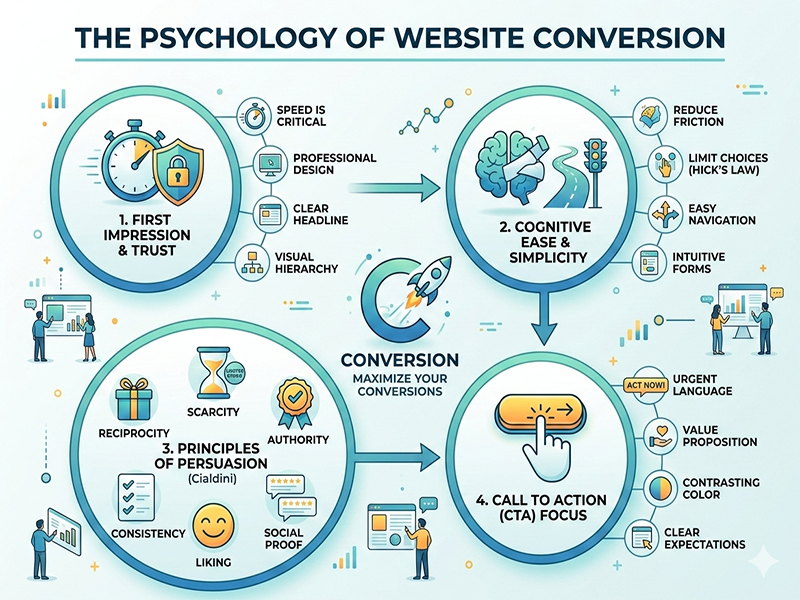
Website Conversion Psychology
Website
conversion psychology is the art and science of understanding why people click
"Buy" or "Sign Up"—and more importantly, why they don't.
It’s less about manipulation and more about removing the mental friction that
stops a user from completing a task.
1.
Cognitive Load and Friction
The human
brain is biologically "lazy"—it seeks the path of least resistance.
If a website is cluttered or confusing, the brain experiences Cognitive Load,
which leads to "Analysis Paralysis."
- Hick’s Law: The time it takes to make a
decision increases with the number and complexity of choices.
- The Solution: Limit navigation options and
have one clear Primary Call to Action (CTA) per page.
2. The
Power of Social Proof
Humans are
social animals. When we are uncertain, we look to others to see how we should
behave. This is known as Informational Social Influence.
- Testimonials & Reviews: Seeing that others had a
positive experience reduces the perceived risk.
- Trust Seals: Logos of well-known brands or
security certifications act as "authority shortcuts" for the
brain.
- "Best Seller" Tags: These guide users toward the
"safe" choice that others have already vetted.
3.
Scarcity and Urgency
The Fear
of Missing Out (FOMO) is a powerful motivator. We value things more when we
perceive them to be rare or time-sensitive.
- Quantity Scarcity: "Only 3 items left in
stock!"
- Time Urgency: "Sale ends in 2 hours and
14 minutes."
- Loss Aversion: Psychologically, the pain of
losing $50 is twice as powerful as the joy of gaining $50. Frame your
offer as "Don't miss out on saving" rather than just
"Save."
4. Visual
Hierarchy and Eye Tracking
Where a user
looks is where their money goes. You can guide a user's focus using specific
visual cues.
- The F-Pattern: Users typically scan web pages
in an "F" shape—top horizontal, a bit further down horizontal,
then a vertical scan on the left.
- Directional Cues: An image of a person looking
toward a signup form or an arrow pointing at a button will instinctively
pull the user's eyes to that spot.
5.
Reciprocity and The "Foot-in-the-Door"
The Law
of Reciprocity states that when you give someone something for free, they
feel a psychological urge to give something back.
- Lead Magnets: Give away a high-quality PDF,
trial, or discount code first.
- Micro-Conversions: Instead of asking for a $1,000
sale immediately, ask for an email address. Once they've said
"yes" to a small request, they are statistically more likely to
say "yes" to a larger one later.