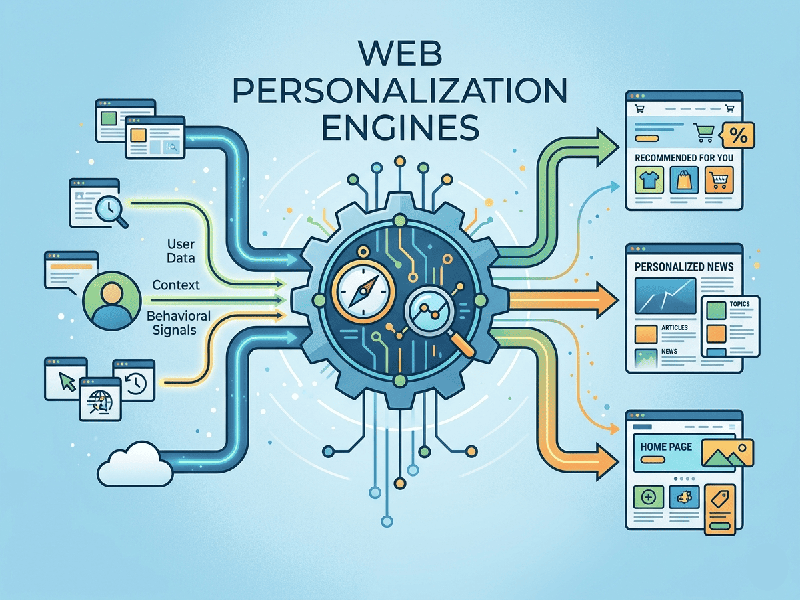
Web Personalization Engines
Web
personalization engines have transitioned from simple "if-then" rule
sets into autonomous, AI-driven systems that act as the "brain" of a
digital ecosystem. They sit between your data layer (like a CDP) and your user
touchpoints to deliver real-time, individualized experiences.
Core
Architecture of a Personalization Engine
Modern
engines generally follow a three-step cycle to turn raw data into a unique user
experience:
1.
Data Unification: They ingest behavioral data (clicks, scroll depth), contextual
data (location, weather, device), and zero-party data (preferences
explicitly shared by the user) to create a single, unified profile.
2.
AI/ML Decisioning: Instead of manual rules, machine learning models predict the
"next-best action." For example, an engine might determine a user has
a 70% probability of churn and instantly trigger a retention offer.
3.
Real-Time Orchestration: The engine pushes the tailored content (dynamic headlines,
product recommendations, or unique layouts) to the website or app at the exact
moment the page loads.
Key
Trends & Technologies in 2026
- Agentic Personalization: Moving beyond static
recommendations, AI agents can now execute tasks for the user, such as
automatically building a custom "starter kit" in a shopping cart
based on a professional profile.
- Hyper-Personalized UX (Zero UI): Interfaces are becoming
"fluid." A newcomer might see a simplified, educational
homepage, while a power user sees a high-density dashboard with direct
shortcuts to their frequent tasks.
- Privacy-First Personalization: With the decline of third-party
cookies, engines now rely heavily on first-party data and AI-driven
"cookieless" modeling that respects privacy while still
maintaining relevance.
- Predictive Search: Search bars no longer just
match keywords; they reorder results based on real-time intent, location,
and even current global supply chain status.