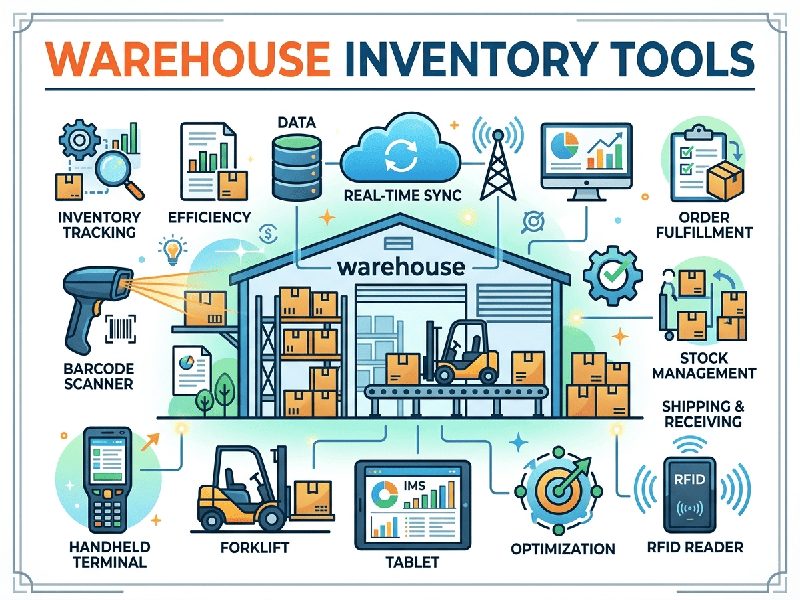
Warehouse Inventory Tools
Managing a modern warehouse requires a combination of
hardware and software to ensure accuracy, speed, and cost-efficiency. To get
the best results, these tools are usually integrated into a single ecosystem.
1. Core Software Systems
The "brain" of the warehouse is the software that
tracks every movement of stock.
- Warehouse Management System
(WMS): The
primary platform used to control and optimize everything from receiving
and put-away to picking and shipping.
- Inventory Management Software
(IMS): Focuses
specifically on stock levels, reorder points, and SKU management across
multiple locations.
- Enterprise Resource Planning
(ERP): Larger
suites that connect warehouse data with other business departments like
finance, sales, and human resources.
2. Hardware and Scanning Technology
Physical tools allow workers to input data into the software
systems in real-time.
- Barcode Scanners: Handheld devices used to read
UPC or SKU labels during the picking and packing process.
- RFID (Radio Frequency
Identification):
Uses electromagnetic fields to automatically identify and track tags
attached to objects. Unlike barcodes, RFID tags can be read without a
direct line of sight.
- Mobile Computers: Ruggedized tablets or
smartphones that allow staff to access the WMS while moving around the
floor.
3. Automation and Robotics
Higher-volume facilities use automated tools to reduce manual
labor and human error.
- Automated Storage and Retrieval
Systems (AS/RS):
Computer-controlled systems for automatically placing and retrieving loads
from specific storage locations.
- Automated Guided Vehicles
(AGVs):
Self-driving forklifts or carts that move inventory along fixed paths.
- Pick-to-Light Systems: Use LED lights on racks to
guide workers to the correct bin and indicate how many items to pick.
4. Analytical and Optimization Tools
These help managers make better decisions about layout and
stock flow.
- Slotting Optimization Tools: Software that analyzes which
items are sold most frequently to determine the best physical location for
them (e.g., placing high-velocity items near the shipping docks).
- Demand Forecasting AI: Predictive tools that analyze
historical data to suggest when to increase or decrease stock levels based
on upcoming trends.