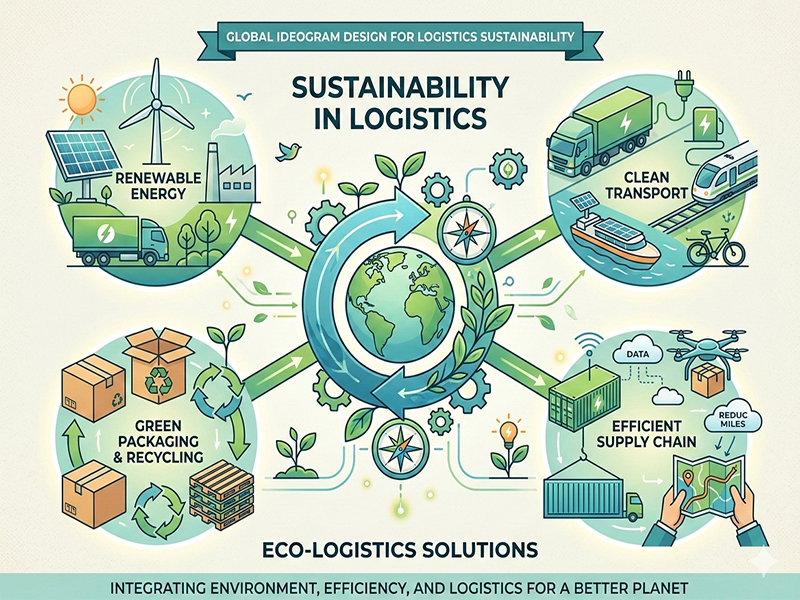
Sustainability in Logistics
Sustainability in logistics has evolved from a "corporate social responsibility" checkbox to a core operational requirement. Driven by stricter carbon taxes (like the EU's CBAM) and consumer demand for transparency, green logistics is now about decarbonization and circularity.
1. Green
Transportation & Alternative Fuels
Transportation
is the largest contributor to the logistics carbon footprint. The shift is
moving beyond just "electric vans" to a multi-modal energy strategy.
- EV & Hydrogen Trucking: Heavy-duty long-haul trucking
is transitioning to Hydrogen Fuel Cells, while "Last-Mile"
delivery has almost entirely shifted to Electric Vehicles (EVs).
- Sustainable Aviation Fuel (SAF): Air freight is reducing its
impact through SAF, which can drop lifecycle carbon emissions by up to
80%.
- Slow Steaming & Wind-Assist: Maritime shipping is
re-adopting "high-tech sails" (rotor sails) to supplement
engines and reduce fuel consumption by 10-20%.
2. Route
Optimization and "Empty Mile" Reduction
The most
sustainable mile is the one you never drive.
- AI-Driven Routing: Real-time algorithms calculate
the most fuel-efficient paths, accounting for traffic, weather, and
vehicle load.
- Backhauling: Historically, many trucks
return empty after a delivery. Modern digital freight platforms match
"empty miles" with available loads from other companies to
ensure near-100% vehicle utilization.
- The Physical Internet: A concept where goods are moved
in modular, standardized "capsules" that can be seamlessly
transferred between different carriers, much like data packets on the
internet.
3.
Sustainable Warehousing (Green Hubs)
Warehouses
are being redesigned as net-zero energy producers rather than just storage
boxes.
- Energy Harvesting: Installing massive solar arrays
on flat warehouse roofs and using regenerative braking on automated
picking robots to feed power back into the grid.
- Passive Cooling: Using high-reflectivity
"cool roofs" and natural ventilation to reduce the massive
energy drain of HVAC systems.
- Urban Micro-hubs: Small, localized fulfillment
centers that allow for bicycle or walking deliveries, eliminating the need
for large trucks in congested city centers.
4.
Circular Packaging & Waste Reduction
The
"Take-Make-Waste" model is being replaced by Circular Logistics.
- Reusable Packaging Systems: Instead of cardboard boxes,
companies are using durable, tracked plastic crates that are collected,
sanitized, and reused hundreds of times.
- Biodegradable Materials: Using mushroom-based packaging
or seaweed-derived films to replace Styrofoam and single-use plastics.
- Right-sizing: Using "on-demand"
packaging machines that create a box perfectly fitted to the item,
reducing the "shipping air" and allowing more packages to fit in
a single vehicle.