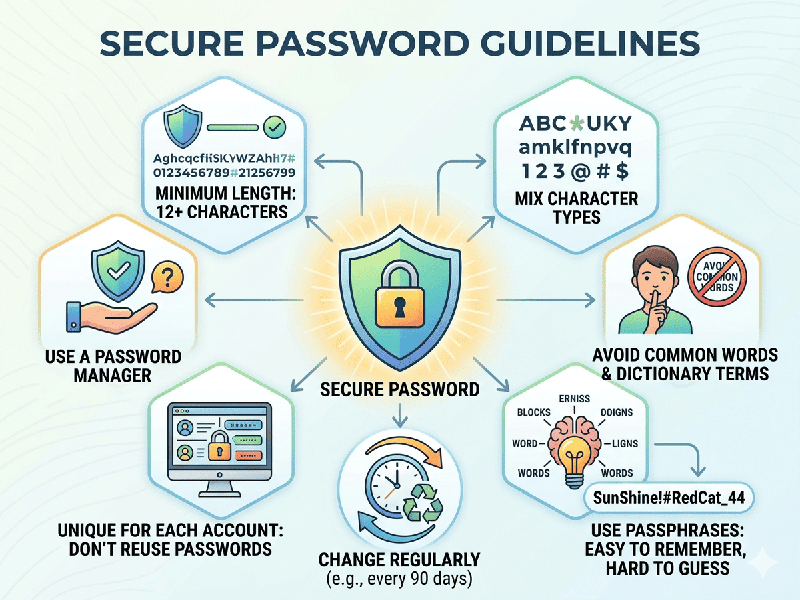
Secure Password Guidelines
Creating a strong password is your first line of defense
against cyber threats. Gone are the days when simply swapping an "s"
for a was enough; today’s hackers use sophisticated
"brute-force" attacks that can guess simple combinations in seconds
1. Complexity & Length
The longer the password, the harder it is to crack. While
complexity matters, length is often more effective against modern
hacking tools.
- Minimum Length: At least 12 to 16 characters.
- The Mix: Use a combination of uppercase
letters, lowercase letters, numbers, and special symbols (e.g., !, @, #,
*).
- Avoid Predictability: Do not use sequential numbers
(1234), keyboard patterns (qwerty), or personal info (birthdays, pet
names, or your username).
2. The "Passphrase" Method
Instead of a hard-to-remember string like P@ssw0rd123!, use a Passphrase. This is a string of random, unrelated words.
This is much easier for a human to remember but significantly
harder for a computer to guess because of the character length.
3. Core Security Habits
Even the strongest password can be stolen. Follow these
habits to stay protected:
- Unique Passwords: Never reuse the same password
across multiple sites. If one site is breached, all your accounts are
compromised.
- Use a Password Manager: Tools like Bitwarden,
1Password, or Dashlane generate and store complex passwords so you only
have to remember one "Master Key."
- Enable Multi-Factor
Authentication (MFA): This is the most important step. Even if a hacker gets your
password, they can't get in without a second code from your phone or an
app.