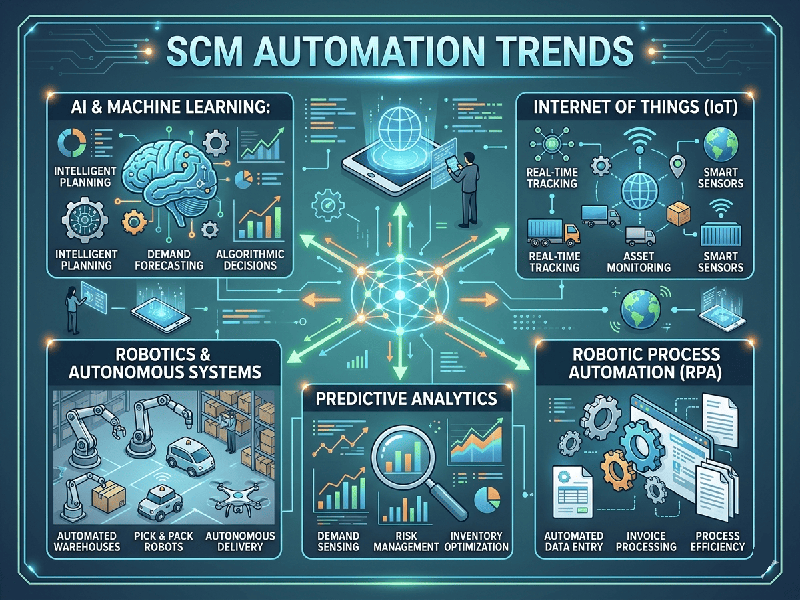
SCM Automation Trends
SCM Automation Trends: The 2026 Shift
Supply Chain Management (SCM) has moved beyond
simple digitization. The current focus is on "Agentic AI" and "Self-Healing"
networks—systems that don't just alert humans to a problem but actively work to
resolve it.
1. The Rise of Agentic AI & Autonomous Orchestration
The most significant trend this year is the transition from
predictive AI (which forecasts what might happen) to agentic AI (which acts
on those forecasts).
- Self-Healing Chains: AI agents now autonomously
renegotiate freight rates, reroute shipments during port closures (like
the recent disruptions in global maritime lanes), and adjust inventory
levels across regional hubs without manual intervention.
- Multi-Agent Collaboration: Different AI assistants—for
procurement, demand forecasting, and logistics—now "talk" to
each other to synchronize departmental decisions, ending the era of
functional silos.
2. Operational Digital Twins & Predictive Simulation
Digital twins have evolved from static 3D models into live
network simulators.
- "What-If" Stress
Testing:
Companies use digital twins to simulate the impact of geopolitical shifts,
extreme weather, or labor strikes in real-time.
- Execution Linkage: These models are now directly
connected to execution systems (WMS/TMS), allowing for immediate
implementation of the "best-case" scenario discovered in the
simulation.
3. Hyper-Local & Micro-Fulfillment Automation
Driven by the demand for sub-2-hour delivery in urban
centers, automation is getting smaller and closer to the consumer.
- Dark Stores & MFCs: High-density, automated
Micro-Fulfillment Centers (MFCs) are being integrated into existing retail
footprints or urban "dark stores" to minimize last-mile costs.
- Modular Robotics: Instead of massive fixed
conveyor systems, 2026 is the year of Modular AMRs (Autonomous Mobile
Robots) that can be scaled up or down based on seasonal demand.
4. Verifiable Sustainability (Blockchain + IoT)
Sustainability has shifted from "marketing" to
"mechanical necessity" due to stricter global carbon regulations.
- Digital Product Passports: Automation tools now pull data
from IoT sensors and store it on blockchain ledgers to provide a
tamper-proof "green score" for every SKU.
- Circular Logistics: Automated reverse-logistics
systems are being designed specifically to handle product returns,
repairs, and recycling, turning waste into a resource stream.