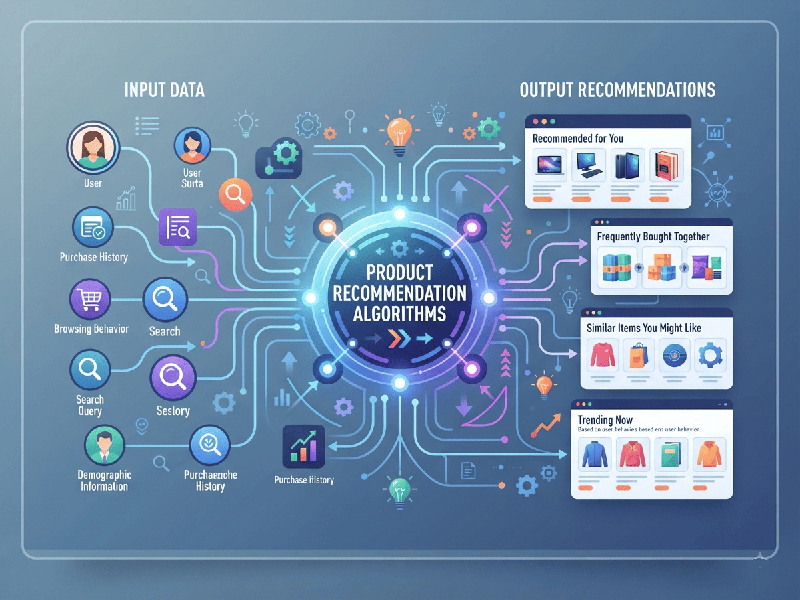
Product Recommendation Algorithms
Product recommendation algorithms are AI-powered data systems designed
to predict and suggest the most relevant products to users on e-commerce
platforms, streaming sites, and retail apps. They combat information overload,
reduce decision fatigue, and drive conversion rates and average order values.
Core Types of Recommendation Algorithms
1. Collaborative Filtering (CF)
Collaborative filtering relies on past user behavior
and interactions. It assumes that if two people agreed on past items (like
products or ratings), they will likely agree on future ones.
- User-User CF: Finds users with similar
shopping habits and recommends products that peer groups bought. (Example:
"Users similar to you also bought...")
- Item-Item CF: Looks at the similarity between
items based on how users interact with them. (Example: "People who
bought this smartphone also bought this specific case.")
- Pros: Highly effective; requires no
deep metadata about the items themselves.
- Cons: Suffers from the cold start
problem (struggles to recommend things to brand-new users or feature
brand-new items with no interaction history).
2. Content-Based Filtering
Content-based filtering matches product metadata
(features, descriptions, tags, categories, brands) directly with a user's known
profile or preferences.
- How it works: If a customer frequently
searches for or buys red running shoes made of breathable mesh, the
algorithm scans the catalog for items sharing those exact text tags and
attributes.
- Pros: Great for handling new items;
transparent reasoning (easy to explain why an item was
recommended).
- Cons: Can lead to an echo
chamber/over-specialization (e.g., continually showing running shoes
and never suggesting complementary gear like water bottles or socks).
3. Hybrid Recommendation Systems
Hybrid systems combine collaborative filtering,
content-based filtering, and other techniques to maximize accuracy and minimize
individual weaknesses.
- How it works: A platform might use
collaborative filtering to narrow down general user preferences, and
content-based filtering to fine-tune the final selection based on specific
constraints (like price range or sizing). Most major modern platforms
(like Amazon or Netflix) utilize complex hybrid models.
4. Contextual & Global Algorithms
These systems factor in the immediate environment or
high-level popularity trends rather than just deep personal history:
- Global/Trending: Recommends top-sellers,
seasonal items, or highest-rated products. Ideal for first-time visitors
with zero data footprint.
- Contextual: Adapts dynamically based on
time of day, current weather, physical location, or device type (e.g.,
pushing rain jackets when it’s raining in the user's GPS zone).
Advanced Mathematical & Structural Approaches
Underneath the core types, engineers deploy various
advanced models:
- Matrix Factorization (SVD): A dimensionality-reduction
mathematical technique used heavily in collaborative filtering to predict
missing ratings in a massive user-item grid.
- Graph-Based Algorithms (e.g.,
Breadth-First Search, PageRank): Maps out shoppers, products, and actions as
interconnected nodes in a graph network to spot deep relationship paths
and trending influential products.
- Deep Learning & Neural
Networks: Employs
sequence-based models (like transformers or RNNs) to analyze a user's live
session clickstream in real-time, predicting what they want next while
they are browsing.