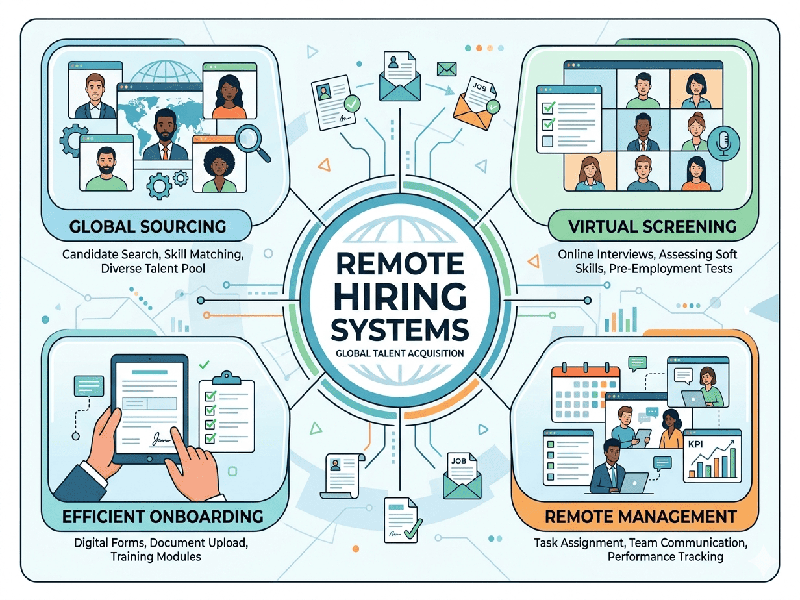
Remote Hiring Systems
Remote
hiring has shifted from a "backup plan" to a highly automated, global
strategy. The modern remote hiring system is designed to solve three
specific challenges: time zone friction, high-volume screening, and cultural
integration.
1. The
Core Infrastructure: "The Stack"
Modern
remote hiring is no longer just about Zoom and email. It is built on integrated
systems that communicate automatically:
- EOR (Employer of Record): Platforms like Deel, Remote,
or Oyster that handle legal compliance, taxes, and local payroll in
150+ countries so you can hire someone in India or Argentina without a
local entity.
- Asynchronous-First Tools: Systems designed for
"one-way" interaction to bypass time zone blockers.
- Loom/Veed: For video-based job
descriptions.
- Hireflix/Willo: For one-way video interviews
where candidates record answers on their own time.
- Agentic ATS (Applicant Tracking
Systems): 2026
versions of Greenhouse or Lever now use "Agentic
AI" that doesn't just store resumes but actively screens, ranks, and
schedules candidates without human intervention.
2. 2026
Remote Hiring Strategies
The
"Nearshore" Shift
Companies
are increasingly moving away from extreme offshoring (12-hour time differences)
toward Nearshoring.
- Example: A company in India hiring from
Southeast Asia or a US company hiring from Latin America.
- Why: Real-time collaboration is
easier when teams share overlapping "core hours" (usually a
4-hour window where everyone is online).
Skills-First
(De-credentialing)
Modern
systems prioritize verified skills over degrees.
- Technical Roles: Using platforms like HackerRank
or Codility for live, proctored coding sessions.
- Non-Technical Roles: Using "Work Samples"
(e.g., a 48-hour paid trial or a specific writing/marketing prompt) to see
how the candidate actually handles a remote task.
3.
Onboarding & Integration (The Final Mile)
The
"system" doesn't stop at the offer letter. In 2026, Automated
Onboarding is a major competitive advantage.
- Hardware Provisioning: Integrated services (like Firstbase
or Hofy) that automatically ship a pre-configured laptop and
ergonomic chair to the new hire's home the day they sign.
- The "Digital Twin"
Onboarding: New
hires enter a virtual workspace (like Gather.town or Topia)
where they can "walk" through a digital office, meeting their
team and learning the company history in an immersive way.
- Shadowing & Documentation: Since you can't tap a neighbor
on the shoulder, 2026 systems rely heavily on "Source of Truth"
wikis (Notion, Linear) where every process is documented and
searchable.