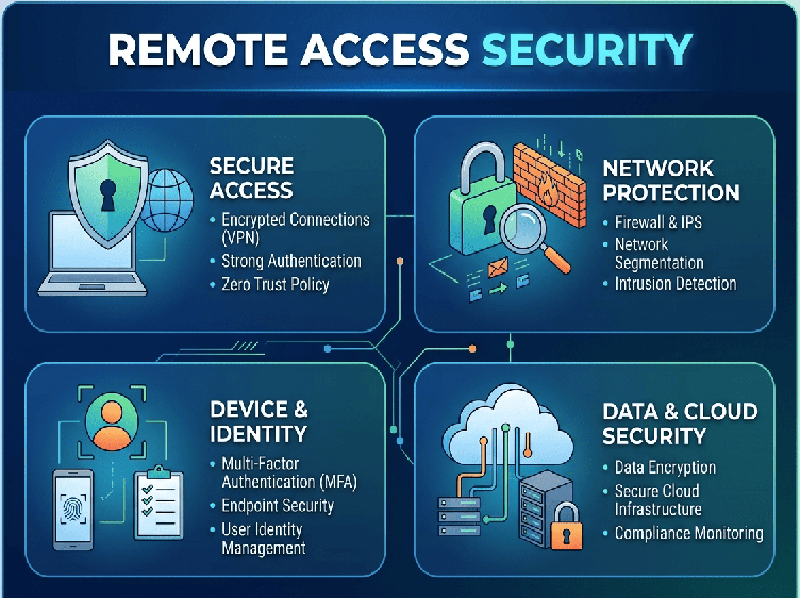
Remote Access Security
Remote Access Security refers to the strategies, policies,
and technologies used to prevent unauthorized access to an organization's
internal network and sensitive data when employees work from off-site
locations.
1. Core Principles of Modern Remote Security
As the traditional "office perimeter" has
disappeared, security has shifted from protecting a building to protecting the user
and the device.
- Zero Trust Architecture (ZTA): The fundamental principle of
"never trust, always verify." Every access request is treated as
if it originates from an open network, requiring strict identity
verification.
- Least Privilege Access: Users are only granted the
minimum level of access necessary to perform their specific job functions,
limiting the "blast radius" if an account is compromised.
- Continuous Monitoring: Real-time analysis of user
behavior to detect anomalies, such as a login from an unusual geographic
location or at an odd hour.
2. Essential Security Technologies
To build a robust remote access framework, organizations
typically deploy a combination of the following:
A. Endpoint Protection
Securing the actual hardware (laptops, mobiles) used by
employees.
- EDR (Endpoint Detection and
Response): Tools
that monitor devices for malicious activity.
- MDM (Mobile Device Management): Allows IT teams to remotely
wipe data if a device is lost or stolen.
B. Connection Security
- VPN (Virtual Private Network): Creates an encrypted
"tunnel" between the remote user and the office network.
- ZTNA (Zero Trust Network
Access): A more
modern alternative to VPNs that provides seamless, encrypted access to
specific applications rather than the entire network.
C. Identity & Access Management (IAM)
- MFA (Multi-Factor
Authentication):
Requiring two or more verification methods (e.g., a password plus a mobile
app code).
- SSO (Single Sign-On): Allows users to log in once to
access all authorized applications, reducing "password fatigue"
and the risk of weak passwords.
3. Top Remote Access Risks in 2026
Security teams must actively defend against these evolving
threats:
- Phishing & Social
Engineering:
Sophisticated AI-generated emails designed to steal login credentials.
- Insecure Wi-Fi: Employees working from cafes or
airports using unencrypted public networks.
- Shadow IT: Remote workers using
unauthorized third-party apps to store company data.
- Home Network Vulnerabilities: Compromised smart home devices
(IoT) serving as a backdoor into a work laptop.