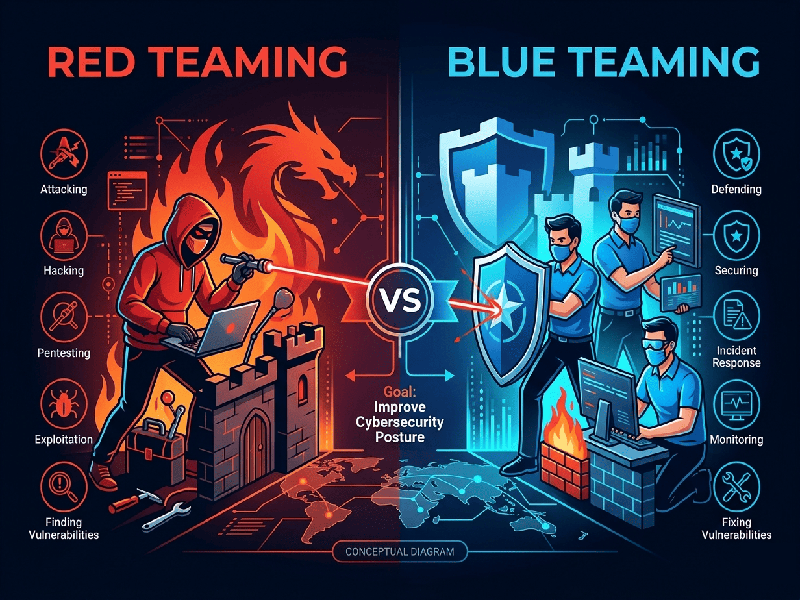
Red Teaming vs Blue Teaming
In
cybersecurity, Red Teaming and Blue Teaming represent the two
sides of a simulated attack. While they have different objectives, they work
together to improve an organization’s overall security posture.
Think of it
as a sparring match: one side tries to find the openings, while the
other practices blocking and counter-striking.
Red Teaming (The Offense)
The Red Team
acts as the "adversary." Their goal is to overcome cybersecurity
controls by simulating a real-world attack. They don’t just look for bugs; they
look for vulnerabilities in people, processes, and technology.
- Mindset: Creative, persistent, and
deceptive.
- Tactics: * Social Engineering:
Phishing emails or physically entering a building.
- Penetration Testing: Exploiting software
vulnerabilities.
- Credential Theft: Stealing passwords or
bypassing authentication.
- Goal: To demonstrate how a real
attacker could break in and what data they could steal.
Blue Teaming (The Defense)
The Blue
Team is the internal security team responsible for maintaining the
"fortress." Their job is to detect, oppose, and survive the Red
Team’s (or a real hacker’s) attacks.
- Mindset: Analytical, vigilant, and
reactive.
- Tactics:
- Log Analysis: Monitoring network traffic for
suspicious patterns.
- Incident Response: Shutting down systems or
blocking IPs during an attack.
- Hardening: Updating
"firewalls", patching software, and enforcing strict access.
- Goal: To strengthen defenses and
minimize the "mean time to detect" (MTTD) an intruder.
Purple Teaming: The Integration
The most
effective organizations use a Purple Team approach. This isn't
necessarily a separate group, but a collaborative mindset where Red and Blue
teams share constant feedback.
- The Workflow: The Red Team explains exactly
how they broke in, and the Blue Team explains why they didn't see
it.
- Result: Security improvements happen in
weeks rather than months.