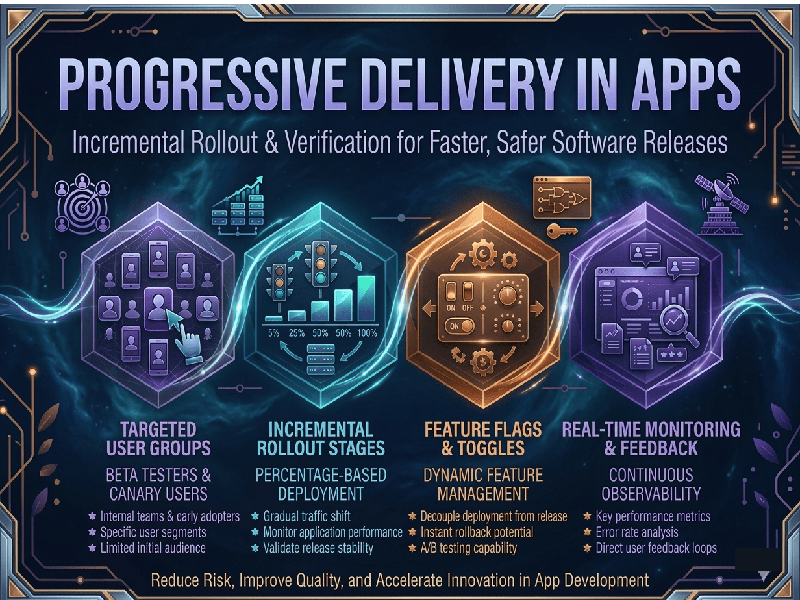
Progressive Delivery in Apps
Progressive Delivery is the modern evolution of Continuous Delivery. While Continuous Delivery focuses on getting code to a production environment safely, Progressive Delivery focuses on how that code is actually exposed to users.
The Core
Pillars of Progressive Delivery
1.
Release vs. Deployment
In
traditional models, deploying code meant releasing it to everyone. In
Progressive Delivery, these are decoupled:
- Deployment: The technical act of moving
code to production servers.
- Release: The business decision of when
and to whom a feature becomes visible.
2.
Feature Flags (Toggles)
Feature
flags are the "engine" of this approach. Developers wrap new code in
a conditional statement, allowing them to turn features on or off for specific
user segments without redeploying the entire app.
3. Blast
Radius Control
The goal is
to limit the "blast radius" if something goes wrong. If a new update
crashes the app, you want it to crash for 1% of users, not 100%.
Modern
Patterns & Strategies
A. Canary
Releases
You roll out
the new version to a tiny subset of users (the "canaries"). You
monitor health metrics (latency, error rates); if they remain stable, you
slowly increase the percentage until everyone is on the new version.
B.
Blue-Green Deployment
You maintain
two identical production environments. "Blue" is the current version;
"Green" is the new one. You switch traffic from Blue to Green. If a
bug appears, you flip the switch back instantly.
C. Ring
Deployment (User Segments)
Users are
grouped into "rings" based on risk tolerance:
1.
Ring 0:
Internal developers (Canary).
2.
Ring 1: Beta
testers/Early adopters.
3.
Ring 2:
General audience.
D. A/B
Testing and Experimentation
Beyond just
stability, Progressive Delivery allows you to measure impact. You can
give half your users "Feature A" and the other half "Feature
B" to see which drives more engagement before committing to one.