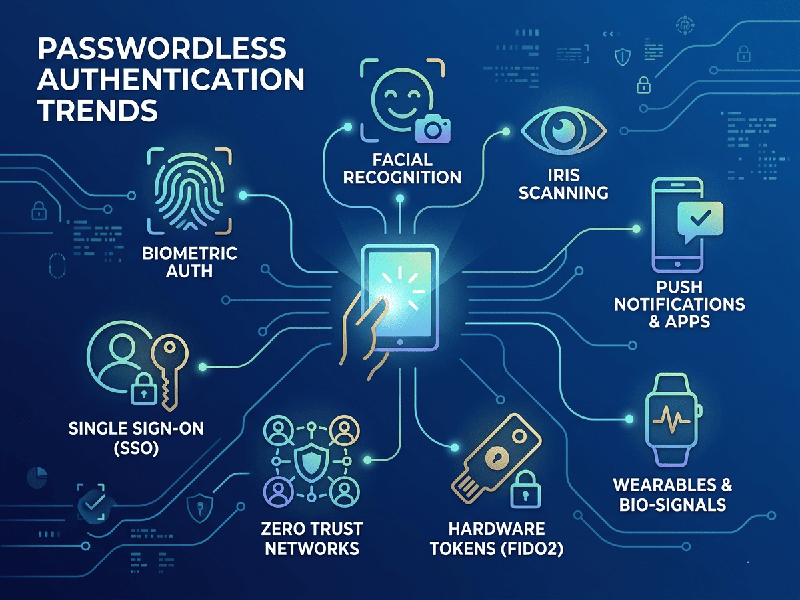
Passwordless Authentication Trends
As of 2026, the transition toward a passwordless future
has reached a critical tipping point. While the majority of organizations still
support legacy password options, passwordless methods are rapidly becoming the
"default" for both consumer and enterprise ecosystems.
The market is projected to grow from $21.58 billion in
2025 to over $24.85 billion in 2026, reflecting a massive shift in how we
handle digital identity.
1. The Rise of Passkeys (FIDO2/WebAuthn)
Passkeys have become the "gold standard" for
passwordless security. They are essentially cryptographic keys stored on a
user's device (phone, laptop, or security key) that replace the need for a
typed password.
- Widespread Adoption: In 2026, nearly 48% of the
top 100 websites now support passkeys, up significantly from previous
years.
- Phishing Resistance: Unlike passwords or SMS codes,
passkeys cannot be phished remotely because they require local device
access and a biometric "unlock" (like Face ID or a fingerprint).
2. Biometrics as the Primary Factor
Biometric verification is the largest segment of the
passwordless market, expected to hold over 35% of the market share this
year.
- Fingerprint & Facial
Recognition:
These remain the most common methods, integrated into almost every
smartphone and modern PC (Windows Hello, Touch ID).
- Iris & Voice Recognition: These are seeing high growth in
high-security sectors like healthcare and finance due to their extreme
difficulty to replicate.
3. AI-Enhanced Continuous Authentication
One of the most significant trends in 2026 is moving beyond a
one-time login.
- Behavioral Monitoring: AI models now track
"continuous" signals like typing rhythm, mouse movements, and
device posture. If these signals deviate during a session, the system can
automatically re-verify the user.
- Anomaly Detection: AI identifies "impossible
travel" (logging in from two distant locations too quickly) or
suspicious device clones in real-time.
4. Zero Trust and Enterprise Shift
Enterprises are moving away from the "perimeter"
security model toward Zero Trust, where passwordless auth is a central
pillar.
- Cost Reduction: Organizations are seeing
significant savings; password-related support tickets (like resets) can
cost large firms up to $1.75 million annually.
- Microsoft & Google Impact: With Microsoft and Google
accounts now being "passwordless by default," the cultural
friction of moving away from traditional credentials has largely
disappeared for employees.
5. Transition Challenges
Despite the momentum, the "password" isn't dead
yet:
- Legacy Systems: Many older enterprise
applications are incompatible with modern FIDO2 standards, requiring
"bridge" technologies or magic links as a halfway step.
- Privacy Concerns: As biometric usage scales,
there is ongoing legislative debate and user concern regarding how
biometric templates are stored (though modern standards store them locally
on the device, not in the cloud).