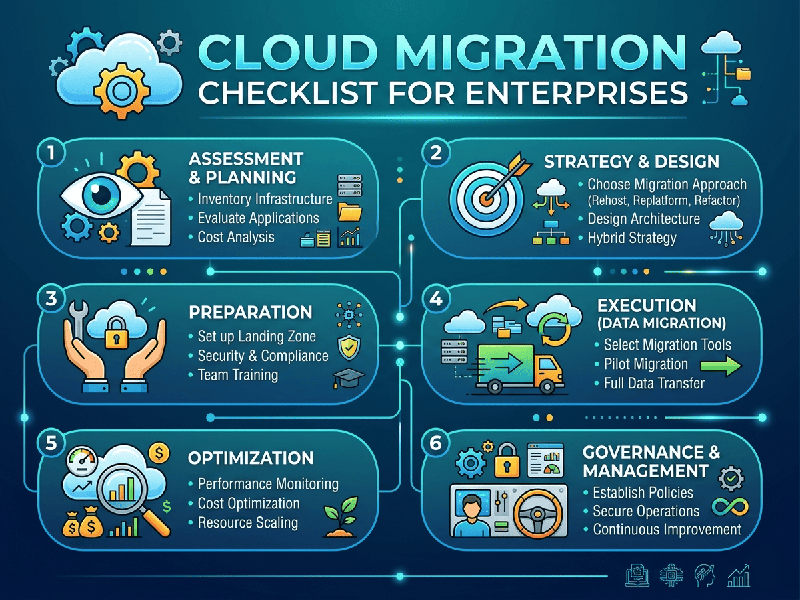
Cloud Migration Checklist for Enterprises
Migrating to the cloud is a high-stakes evolution for any
enterprise. To ensure a seamless transition that balances performance with
fiscal responsibility, here is a comprehensive checklist structured by phase.
Phase 1: Strategy & Assessment
Before moving a single byte, define the "why" and
"how" of your migration.
- Define Business Objectives: Are you migrating for
scalability, disaster recovery, or data sovereignty?
- Inventory Discovery: Catalog all applications,
dependencies, and hardware. Use automated tools to map how services talk
to each other.
- Cloud Readiness Assessment: Categorize workloads using the 6
Rs:
1.
Rehost (Lift
and Shift)
2.
Replatform
(Lift and Reshape)
3.
Refactor
(Decouple and Rewrite)
4.
Repurchase
(Move to SaaS)
5.
Retire
(Decommission)
6.
Retain (Keep
on-prem)
- Compliance & Regulatory
Check: Ensure
the destination region complies with local data laws (e.g., RBI guidelines
for financial data or GDPR).
Phase 2: Design & Foundation
Establish the "Landing Zone"—the environment where
your workloads will live.
- Network Architecture: Set up Virtual Private Clouds
(VPCs), subnets, and hybrid connectivity (VPN or Direct Interconnect).
- Identity & Access Management
(IAM):
Implement the Principle of Least Privilege. Use Multi-Factor
Authentication (MFA) and Role-Based Access Control (RBAC).
- Security Framework: Define encryption standards for
data at rest and in transit.
- Cost Management Setup: Establish tagging schemas for
different departments to enable accurate Cost Forecasting and
budget alerts.
Phase 3: The Execution (Migration)
This is the "Migration Factory" phase where data
and applications actually move.
- Pilot Migration: Start with a low-criticality
workload to test the pipeline and identify bottlenecks.
- Data Migration Strategy:
o Online: For smaller datasets via the
internet/dedicated lines.
o Offline: For massive data volumes (petabytes)
using physical transfer appliances.
- ERP & Database Tuning: Optimize database instances
specifically for cloud performance to avoid "latency lag" during
the cutover.
- Automated Testing: Validate that the application
behaves in the cloud exactly as it did on-prem.
Phase 4: Optimization & Governance
The migration isn't over when the apps are live; it’s over
when they are efficient.
- Performance Monitoring: Use AI-driven monitoring tools
to track CPU usage, memory, and error rates.
- Rightsizing: Analyze usage patterns and
downsize over-provisioned instances to save costs.
- Knowledge Transfer: Ensure remote and local teams
are trained on the new cloud-native tools and dashboard management.
Post-Migration Audit: Verify that all security patches are active and backup schedules are running successfully.