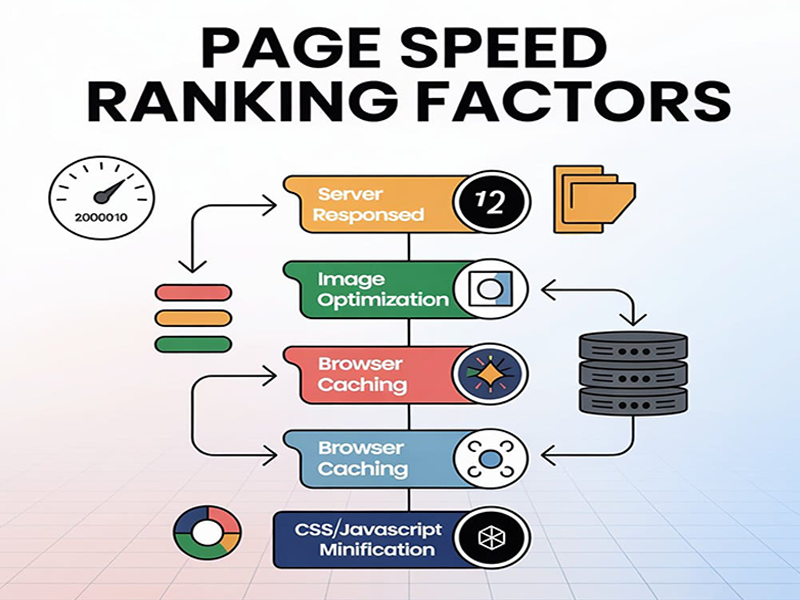
Page Speed Ranking Factors
Page speed
is no longer just a "nice-to-have" for user experience; it is a
documented foundational ranking factor for both desktop and mobile search.
Google evaluates speed primarily through a set of metrics known as Core Web
Vitals (CWV), which measure the real-world user experience of a page.
1. Core
Web Vitals (The Primary Signals)
Google uses
these three specific metrics to quantify the "speed" of a page. To
rank well, a page should hit the "Good" threshold for all three.
- Largest Contentful Paint (LCP): Measures loading performance.
This is the time it takes for the largest image or text block to become
visible.
- Interaction to Next Paint (INP): Measures responsiveness.
This replaced First Input Delay (FID) in 2024. It assesses how quickly a
page responds to user inputs like clicks or key presses.
- Cumulative Layout Shift (CLS): Measures visual stability.
This tracks how much elements move around while the page is loading (e.g.,
a button moving because an ad loaded above it).
2.
Critical Technical Ranking Factors
Beyond the
Core Web Vitals, several technical elements determine how quickly a search
engine crawler and a user can access your content.
Time to
First Byte (TTFB)
This
measures the responsiveness of your web server. If your server takes too long
to deliver the first packet of data, every other speed metric will suffer. High
TTFB is often caused by poor hosting, complex database queries, or lack of
caching.
Mobile-First
Indexing
Since Google
primarily uses the mobile version of a site for indexing and ranking, your mobile
page speed is the priority. A fast desktop site will not compensate for a
sluggish mobile experience.
Resource
Optimization
- Image Compression: Large, unoptimized images are
the #1 cause of slow pages. Using modern formats like WebP or AVIF
is now a standard requirement.
- Minification: Removing unnecessary characters
(like spaces and comments) from HTML, CSS, and JavaScript files to reduce
file size.
- Render-Blocking Resources: High-priority JavaScript or CSS
that prevents a page from displaying until the script is fully loaded.
3.
Infrastructure & Delivery Factors
Where and
how your data is stored significantly impacts global ranking potential.
- Content Delivery Network (CDN): Using a CDN stores copies of
your site on servers worldwide, ensuring a user in Mumbai isn't waiting
for data to travel from a server in New York.
- Browser Caching: Instructing browsers to
"remember" certain parts of your site so they don't have to
re-download everything on a return visit.
- HTTP/3 Support: The latest version of the HTTP
protocol, which improves speed and security over older versions.
4. How to
Measure and Improve
To align
your site with these ranking factors, use the following official tools:
1.
Google PageSpeed Insights: Provides both "Lab Data" (simulated) and
"Field Data" (real user experience from the Chrome User Experience
Report).
2.
Google Search Console: The "Core Web Vitals" report shows which pages on
your site are failing the speed thresholds.
3.
Lighthouse: A
tool built into Chrome DevTools for auditing performance during the development
phase.