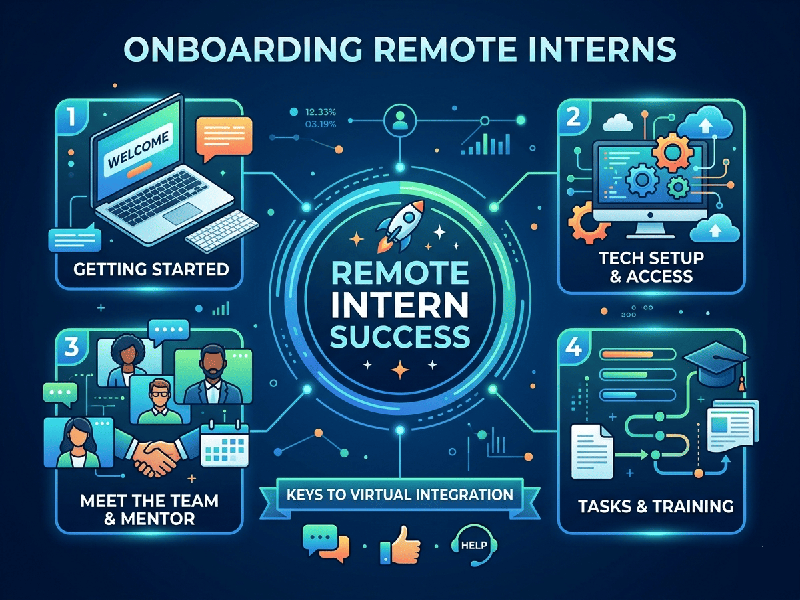
Onboarding Remote Interns
Successfully onboarding remote interns requires a structured
approach that balances clear documentation with consistent human connection.
Since you don't have the benefit of "desk-side" learning, your
digital infrastructure must act as the office.
1. The Pre-Arrival "Zero Day"
Before the intern starts, eliminate technical friction so
they can hit the ground running.
- Access Audit: Ensure all logins (Slack,
Trello/Asana, Google Workspace, CRM) are active 24 hours before they
start.
- The Digital Welcome Kit: Send a single PDF or Notion
link containing:
o Company mission and values.
o Communication etiquette (e.g.,
"Slack for quick wins, Email for formal updates").
o A "Who’s Who" directory
with photos and roles.
2. Structured Orientation
Remote interns often feel "invisible" during their
first week. Over-communication is the remedy.
- The "Welcome" Video
Call: A
face-to-face meeting to discuss expectations, not just tasks.
- The "Shadow" Phase: Assign them to sit in on 2–3
different departmental meetings (Sales, Product, Marketing) to understand
how the "gears" of the business turn.
- The Tech Stack Walkthrough: Don't assume they know your
specific SEO tools or project management workflows. Record a Loom video
or conduct a live screen-share demo.
3. Clear Output Expectations
Ambiguity is the enemy of remote productivity.
- The 30-60-90 Day Plan: Even for short internships,
define what "success" looks like at each milestone.
- The "Daily Stand-up": Use a dedicated Slack channel
for a 3-point update every morning:
1.
What
did I do yesterday?
2.
What
am I doing today?
3.
Where
am I blocked?
4. Documentation & Self-Serve Learning
Build a "Source of Truth" so they don't have to
message you for every small detail.
- Standard Operating Procedures
(SOPs): Create
step-by-step guides for recurring tasks.
- FAQ Repository: A living document where common
intern questions are answered and archived.
5. Mentorship & Social Integration
The biggest loss in remote work is the
"watercooler" conversation.
- The Buddy System: Pair them with a junior staff
member (not their direct manager) for "low-stakes" questions.
- Virtual Coffee Breaks: Schedule 15 minutes of non-work
chat once a week to build rapport.