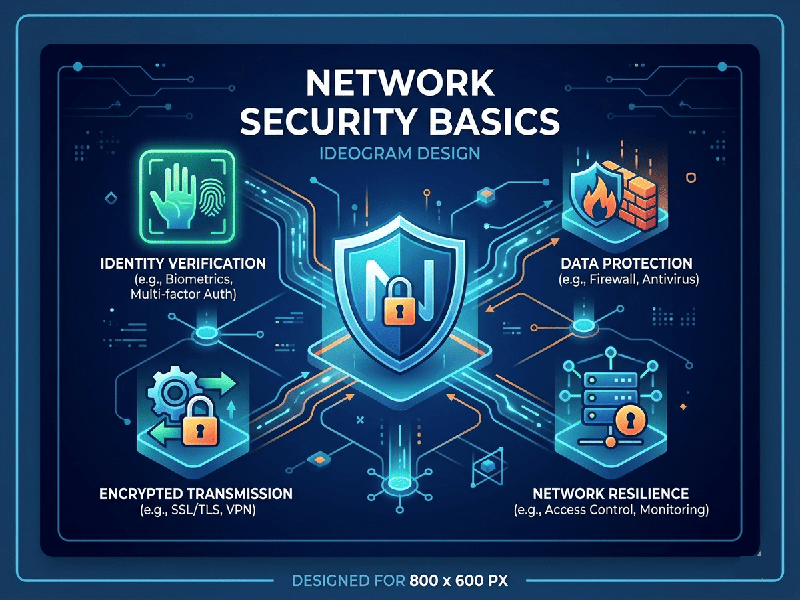
Network Security Basics
Network security is the practice of protecting a computer
network’s infrastructure, data, and accessibility from unauthorized access,
misuse, or theft. It involves a combination of hardware devices, software
technologies, and strategic policies.
To understand the basics, it helps to look at the three
primary pillars often referred to as the CIA Triad:
- Confidentiality: Ensuring that data is
accessible only to those authorized to have access.
- Integrity: Maintaining the consistency,
accuracy, and trustworthiness of data over its entire lifecycle.
- Availability: Ensuring that the network
resources and data are available to users when they need them.
Core Components of Network Security
1. Firewalls
A firewall acts as a barrier between a trusted internal
network and untrusted external networks (like the internet). It uses a set of
defined rules to allow or block traffic.
2. Access Control
Not every user should have access to every part of the
network. Access control involves:
- Authentication: Verifying who the user is
(e.g., passwords, biometrics).
- Authorization: Determining what the
authenticated user is allowed to do.
3. Encryption
Encryption transforms readable data (plaintext) into an
unreadable format (ciphertext). Even if data is intercepted during
transmission, it cannot be read without the correct decryption key. This is
essential for secure web browsing (HTTPS) and Virtual Private Networks (VPNs).
4. Intrusion Prevention Systems (IPS)
While a firewall blocks traffic based on rules, an IPS
actively scans network traffic to identify and block exploits, such as
"brute force" attacks or known software vulnerabilities.
5. Malware Protection
Software designed to identify, block, and remove malicious
software like viruses, worms, ransomware, and spyware.