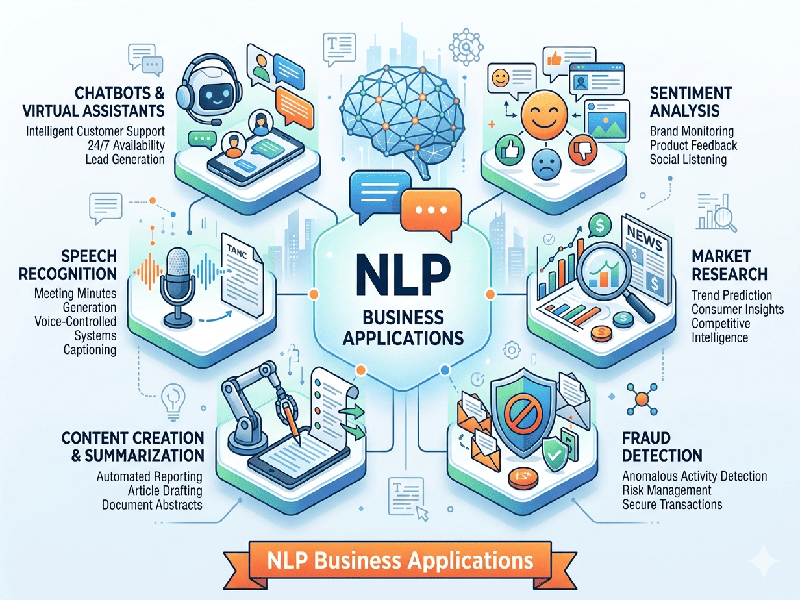
NLP Business Applications
Natural
Language Processing (NLP) has evolved from a back-office experimental tool into
a core driver of business intelligence and customer experience. In 2026, the
focus has shifted from simple keyword matching to Agentic NLP, where
systems not only understand intent but also execute complex tasks autonomously.
1.
Customer Experience and Support
This is the
most mature application of NLP, focusing on reducing
"time-to-resolution" and improving satisfaction scores.
- Intelligent Self-Service: AI agents handle nuanced
queries that previously required humans, such as explaining complex
billing discrepancies or navigating multi-step onboarding processes.
- Sentiment & Intent Analysis: Beyond just
"positive" or "negative," modern NLP identifies
specific emotions (frustration, urgency, hesitation) to prioritize
high-value or high-risk tickets in real-time.
- Real-time Agent Assist: While a human agent speaks to a
customer, NLP "listens" to the conversation and pulls up
relevant documentation, compliance scripts, or discount codes
automatically.
2. Market
Intelligence and Competitive Analysis
NLP allows
businesses to process the massive amounts of unstructured data generated across
the web to find actionable insights.
- Social Listening at Scale: Analyzing millions of social
media mentions, forum posts, and reviews to identify emerging product
trends or "brand health" shifts before they hit mainstream
reports.
- Automated Regulatory Tracking: For industries like finance and
healthcare, NLP tools scan thousands of pages of government gazettes and
policy updates (such as RBI circulars or global trade compliance shifts)
to flag necessary operational changes.
- Competitor Benchmarking: Extracting pricing data,
feature updates, and customer complaints from competitor websites and
public filings to inform product roadmaps.
3.
Operational Efficiency and HR
Internal
processes often suffer from "document fatigue," which NLP effectively
solves.
- Intelligent Document Processing
(IDP):
Automatically extracting data from invoices, purchase orders, and legal
contracts, then syncing that data directly into ERP systems like SAP or
Oracle.
- Resume Screening & Talent
Matching: NLP
parses resumes to match candidates not just by keywords, but by the
semantic meaning of their experience and skills, reducing bias and
time-to-hire.
- Knowledge Management: Turning an organization’s
internal "messy" data (PDFs, Slack logs, old emails) into a
searchable, conversational knowledge base for employees.
4. Sales
and Marketing Personalization
NLP allows
for "hyper-personalization" that scales across thousands of leads.
- Semantic SEO & Content
Strategy:
Moving beyond "keyword stuffing" to understand the search
intent of customers. NLP tools help create content that answers the
specific questions users are asking in their own language.
- Email Outreach Automation: Generating highly personalized
"cold" outreach or nurture sequences based on a lead’s recent
LinkedIn activity or published company reports.
- Predictive Lead Scoring: Analyzing the language used in
early-stage sales calls or emails to predict which leads are most likely
to close.