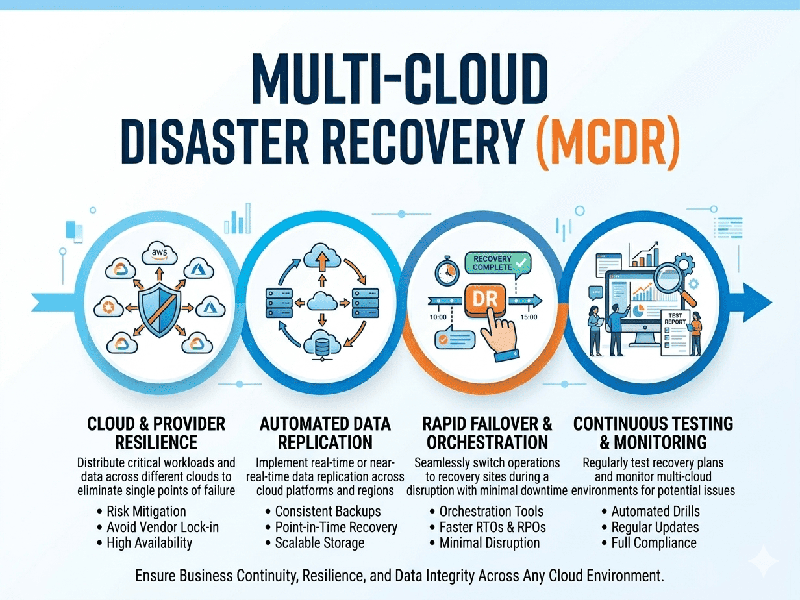
Multi-Cloud Disaster Recovery
Setting up a Multi-Cloud Disaster Recovery (DR) strategy is like having a spare key to your house, but keeping it at a neighbor’s place across town rather than under your own doormat. If one cloud provider (like AWS) has a massive regional outage, your business stays online by "failing over" to another (like Azure or Google Cloud).
1. Why Go
Multi-Cloud for DR?
While a
single cloud provider offers multiple "Regions," a total platform
outage—though rare—can happen due to global DNS issues or account-level
security breaches. Multi-cloud DR provides:
- True Redundancy: Protection against a single
provider’s systemic failure.
- Avoidance of Vendor Lock-in: You aren't beholden to one
company's pricing or terms.
- Compliance: Many industries (like banking)
now require "provider diversity" for critical data.
2. The
Technical Components
To make this
work, you need three "pillars" to be synchronized:
A. Data
Replication
Your data
must live in both places. You can use:
- Database Replication: e.g., an RDS instance in AWS
replicating to a SQL instance in Azure.
- Object Storage Sync: Tools like Rclone or native
cloud "Storage Transfer" services to move files between S3 and
Google Cloud Storage.
B.
Traffic Management (DNS)
You need a
"Global Server Load Balancer" (GSLB) that sits above both clouds. If
Cloud A goes dark, the DNS (like Cloudflare or Akamai) automatically routes
users to Cloud B.
C.
Infrastructure as Code (IaC)
Since the
environments are different (an AWS EC2 is not the same as an Azure VM), you
should use Terraform. It allows you to write one set of configuration
files to deploy resources across different providers consistently.
3. The
Challenges to Watch For
- Egress Costs: Cloud providers often charge
you to move data out of their network. Constantly syncing TBs of
data to a second cloud can get expensive.
- Network Latency: Syncing data across different
providers' backbones is usually slower than syncing within the same
provider's regions.
- Complexity: Your IT team now has to be
experts in two different platforms (e.g., AWS IAM and Azure AD).