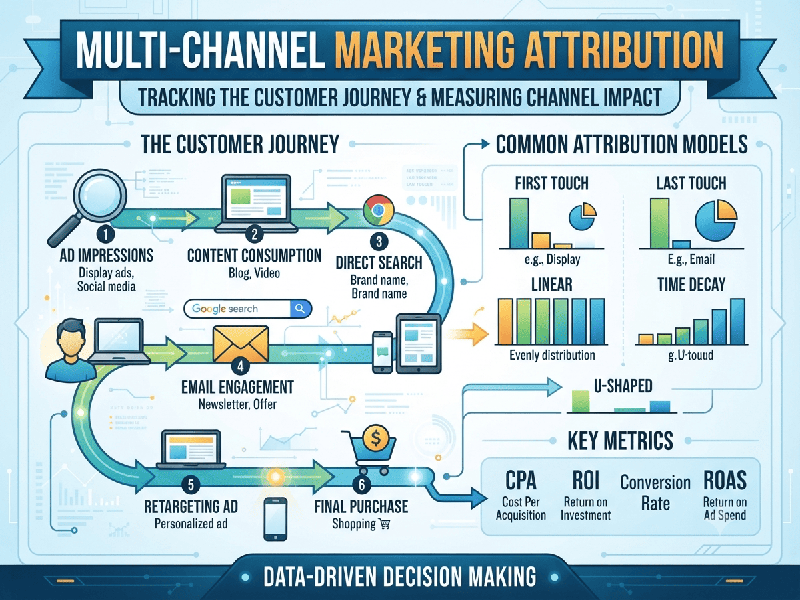
Multi-Channel Marketing Attribution
Multi-Channel Marketing Attribution is the analytical process of
determining which marketing touchpoints—such as social media ads, email
campaigns, organic search, or influencer partnerships—deserve credit for a
conversion or sale.
In a modern customer journey, users rarely convert
after seeing a single ad. They might discover a brand on Instagram, research it
on Google, sign up for a newsletter, and finally purchase after clicking a
retargeting ad. Attribution models help you understand the weight of
each step in that sequence.
Common Attribution Models
Choosing the right model depends on your business
goals and how complex your customer journey is.
- First-Touch Attribution: Gives 100% of the credit to the
very first interaction. Best for understanding what drives initial brand
awareness.
- Last-Touch Attribution: Gives 100% of the credit to the
final interaction before conversion. Simple, but often ignores the
"nurturing" process that happened earlier.
- Linear Attribution: Distributes credit equally
across every touchpoint the user interacted with. Useful for seeing the
"big picture" of a long sales cycle.
- Time-Decay Attribution: Gives more credit to
touchpoints that occurred closer to the conversion. Useful for short-term
campaigns where the final nudge is critical.
- Position-Based (U-Shaped)
Attribution: Assigns
40% credit to the first touch, 40% to the last touch, and splits the
remaining 20% among the intermediate interactions. This recognizes both
the "discovery" and "closing" phases.
- Data-Driven Attribution (DDA): Uses machine learning to
analyze actual path data and assign credit based on the incremental impact
of each touchpoint. This is the most accurate, but requires high-quality
data.
Key Components for Success
1.
Unified Data Strategy: You must integrate data from all channels (Google Analytics,
CRM, ad platforms, email tools) into a single "source of truth."
2.
Cross-Platform Tracking: Utilize UTM parameters, pixel tracking, and server-side
tagging to ensure you aren't losing the thread when a user moves from mobile to
desktop or across different browsers.
3.
Customer Identity Resolution: Linking different devices and browser sessions to a single
unique user ID is essential for accurate multi-channel tracking.
4.
Privacy Compliance: As cookies become less reliable (the "cookieless future"),
shift toward first-party data strategies (e.g., email sign-ups) to maintain
attribution accuracy.
Strategic Benefits
- Optimized Budget Allocation: Stop wasting spend on
low-impact channels and double down on the sequences that actually drive
revenue.
- Better Content Strategy: Understand which types of
content move customers from one stage of the funnel to the next.
- Improved ROI Measurement: Gain a clearer understanding of
your Cost Per Acquisition (CPA) by viewing it through the lens of the full
customer journey rather than isolated platform reports.
Implementation Best Practices
- Start Simple: Don't jump to complex
data-driven models if your data collection is inconsistent. Start with
Linear or Time-Decay to establish a baseline.
- Align with Business Objectives: If you are an organic food firm
like Agrived Foods, your journey might be long. A Linear or
U-Shaped model might be more appropriate than a simple Last-Touch model.
- Visualize the Data: Use tools like Power BI or
Tableau to create dashboards that show the customer path. When building
these, ensure all revenue and cost-saving metrics utilize the ₹ (Rupee)
symbol for clear local market reporting.
- A/B Test Your Channels: Attribution isn't just about
measurement; it's about experimentation. Use your attribution insights to
run "incrementality tests"—turn off a channel for a control
group to see if total conversions actually drop.