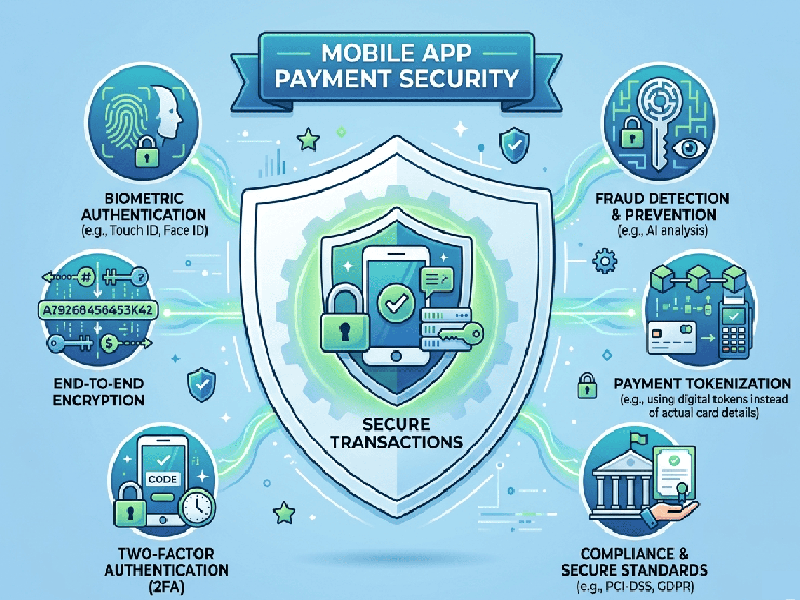
Mobile App Payment Security
As mobile
commerce grows, payment security has shifted from being a technical requirement
to a critical business priority. Ensuring a secure environment involves a
multi-layered approach that protects sensitive data at rest, in transit, and
during the authentication process.
1.
Compliance and Regulatory Standards
Before
implementing any technical features, an app must adhere to global and local
legal frameworks:
- PCI DSS (Payment Card Industry
Data Security Standard): A set of 12 requirements for any app that handles
credit card data. Most modern apps avoid direct "handling" by
using secure tokens.
- EMVCo Standards: The global standard for
chip-based and contactless payments (like NFC payments).
- Regional Regulations: In India, this includes RBI
guidelines on mandatory Two-Factor Authentication (2FA) and
data localization rules for payment data.
2. Core
Security Technologies
To prevent
data breaches and fraud, mobile apps utilize several sophisticated
technologies:
Tokenization
Instead of
storing or transmitting actual 16-digit card numbers (PANs), the app uses a
unique, randomly generated "token." Even if a database is breached,
the tokens are useless to hackers because they cannot be reversed into original
card details.
Encryption
(AES-256 & SSL/TLS)
- Data in Transit: All communication between the
mobile app and the payment gateway must be encrypted using TLS 1.3
to prevent "Man-in-the-Middle" (MITM) attacks.
- Data at Rest: Any sensitive information
stored locally on the device should be encrypted using AES-256 or
stored within the hardware-backed Secure Enclave (iOS) or Trusted
Execution Environment (Android).
3.
Advanced Authentication Methods
Passwords
are increasingly seen as a weak link. Mobile apps now leverage hardware-based
security for better protection:
- Biometric Authentication: Utilizing Fingerprint
(TouchID/Android Biometrics) or Facial Recognition (FaceID) to authorize a
transaction.
- Device Binding: Linking a user’s account to a
specific hardware ID (IMEI or UUID), ensuring that even if a password is
stolen, the account cannot be accessed from an unrecognized device.
- 3D Secure 2.0: An updated protocol that
provides "frictionless" authentication by sharing rich data
between the merchant and the bank to verify the user's identity without
always requiring a manual code.
4.
Preventing App-Level Vulnerabilities
Security
must extend to the code itself to prevent sophisticated mobile-specific
attacks:
- SSL Pinning: Hardcoding the server’s
certificate into the app so it only communicates with the legitimate
server, bypassing fake certificates used by hackers.
- Root/Jailbreak Detection: Preventing the app from running
or performing payments on devices with compromised operating systems,
which are more vulnerable to malware.
- Code Obfuscation: Making the app’s source code
difficult for hackers to reverse-engineer and find vulnerabilities.