Mobile App Architecture Patterns
Selecting the right architecture pattern for a mobile application is a balance between maintainability, testability, and complexity. In 2026, the trend has shifted heavily toward declarative UIs (like SwiftUI and Jetpack Compose), which has reinforced patterns that favor unidirectional data flow.
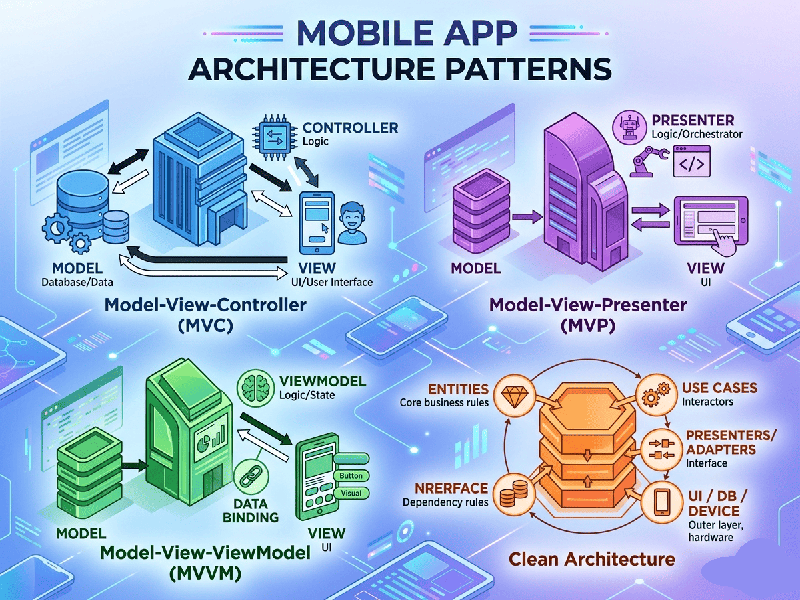
1. MVVM
(Model-View-ViewModel)
MVVM is the
current industry standard for both Android and iOS development. It decouples
the UI from the business logic by using a "Binder."
- Model: Data sources (API, Database).
- View: The UI layer that observes the
ViewModel.
- ViewModel: The "brain." It
fetches data from the Model and transforms it into a state the View can
easily display. It has no knowledge of the View's specific implementation.
2. Clean
Architecture (The Onion Approach)
Clean
Architecture is not just a pattern but a philosophy that organizes code into
concentric layers. The rule is that dependencies can only point inwards.
- Entities: Core business logic.
- Use Cases: Specific business rules (e.g.,
GetUserProfile).
- Interface Adapters: Gateways, Presenters, and
ViewModels.
- Frameworks & Drivers: UI, Database, and Network (the
outermost, most volatile layer).
- Best for: Large-scale enterprise
applications where the underlying database or UI framework might change
over time.
3. MVI
(Model-View-Intent)
MVI has
gained massive popularity with the rise of reactive programming. It relies on a
Unidirectional Data Flow (UDF).
- Intent: The user’s desire to perform an
action (e.g., "Refresh list").
- Model/State: A single, immutable source of
truth for the UI.
- View: Renders the state and sends
Intents back to the business logic.
- Best for: Complex apps with high state
volatility, like fintech dashboards or real-time delivery trackers.
4. VIPER
Commonly
found in the iOS ecosystem, VIPER is an extreme form of Clean Architecture that
splits responsibilities into five distinct parts.
- View: Displays data.
- Interactor: Contains business logic for a
specific task.
- Presenter: Prepares data for the View and
handles UI logic.
- Entity: Basic data objects.
- Router: Handles navigation logic
between screens.
- Best for: Very large teams where multiple
developers need to work on the same module without merge conflicts.