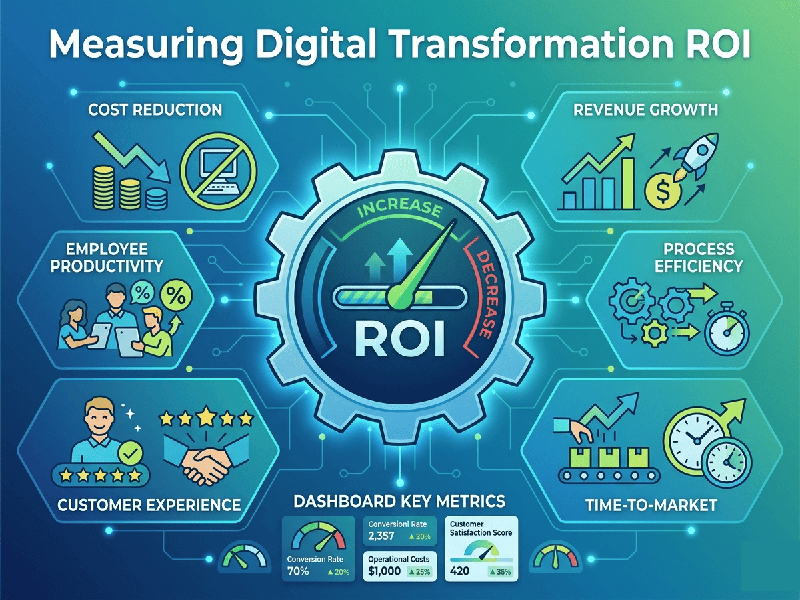
Measuring Digital Transformation ROI
Measuring the Return on Investment (ROI) for digital
transformation is notoriously difficult because, unlike traditional capital
expenditures, the benefits are often intangible, long-term, and spread across
multiple departments.
To get an accurate picture, you need to move beyond simple
financial formulas and look at a balanced scorecard of metrics.
1. The Core ROI Formula
At its most basic level, the formula remains the same, but
the "Gain" is where the complexity lies:
- Cost of Investment: Includes software licenses,
hardware, consulting fees, and—most importantly—the internal labor
hours spent on implementation and training.
- Net Value: The total savings (efficiency)
plus the new revenue generated.
2. Key Performance Indicators (KPIs)
A successful measurement framework categorizes ROI into four
distinct "buckets":
A. Operational Efficiency
These are the most immediate and "hard" numbers to
track.
- Process Cycle Time: How much faster can a task be
completed now?
- Resource Utilization: Are employees spending less
time on manual data entry and more on high-value analysis?
- Cost per Transaction: The reduction in the cost of
executing a single business process (e.g., processing an invoice).
B. Customer Experience (CX)
Digital transformation often fails if it doesn't improve the
end-user journey.
- Customer Lifetime Value (CLV): Are digital tools helping
retain customers longer?
- Net Promoter Score (NPS): Does the new digital interface
improve customer satisfaction?
- Customer Acquisition Cost (CAC): Has automation or better
targeting lowered the cost of finding new clients?
C. Employee Productivity & Culture
- Employee Adoption Rate: How many people are actually
using the new tools versus falling back on old spreadsheets?
- Turnover Rates: Does better tech lead to less
burnout and higher retention?
D. Strategic/Financial Growth
- Revenue from Digital Channels: Tracking sales specifically
generated through new apps or platforms.
- Time-to-Market: How much faster can you launch
a new product using agile digital infrastructure?
3. The "Intangible" ROI
Not everything fits into a spreadsheet. You must also account
for:
- Data Quality: The value of making decisions
based on real-time, accurate data rather than "gut feel."
- Agility: The ability to pivot during a
market shift (like a pandemic or a supply chain crisis).
- Compliance & Risk: Avoiding heavy fines through
automated regulatory tracking and cybersecurity.
4. Implementation Best Practices
- Establish a Baseline: You cannot measure
"improvement" if you don't know your starting numbers. Document
your manual process costs before the transformation begins.
- Iterative Measurement: Don't wait three years to check
the ROI. Measure in "sprints" to see if specific modules are
delivering value.
- The "Valley of
Despair":
Recognize that ROI is often negative in the first 6–12 months due to high
upfront costs and the learning curve.