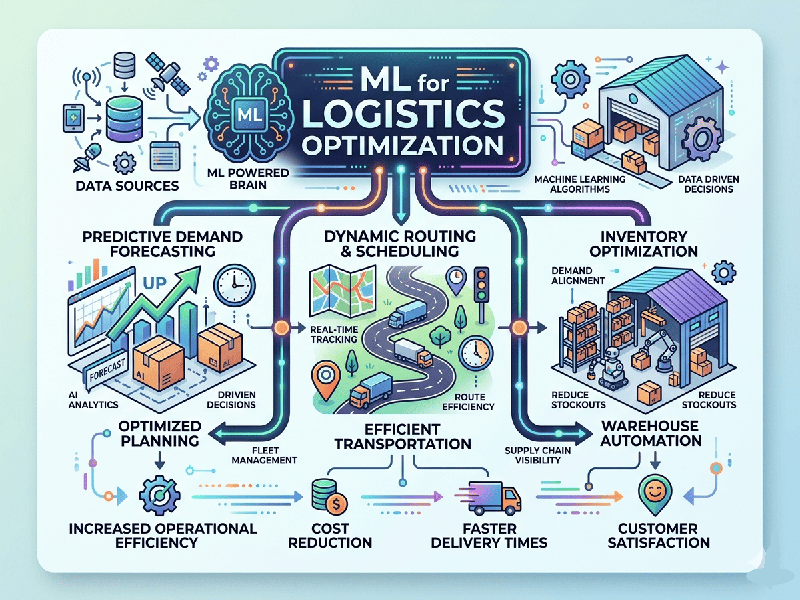
ML for Logistics Optimization
Machine
Learning (ML) has moved from experimental pilots to the core operational layer
of global logistics. By processing massive datasets—from GPS pings and weather
patterns to port congestion and sensor telematics—ML models allow logistics
providers to transition from reactive troubleshooting to predictive
orchestration.
Key
Applications of ML in Logistics
1.
Predictive Demand Forecasting
Traditional
forecasting relies on historical sales. ML models now incorporate external
"signals" to predict spikes before they happen.
- Dynamic Signals: Models analyze social media
trends, economic indicators, and even local event schedules to adjust
inventory positions.
- Granular Accuracy: Instead of forecasting for a
region, ML can predict demand at the SKU-per-neighborhood level,
enabling hyperlocal fulfillment.
2. Route
& Network Optimization
This is the
most mature application of ML, solving the "Traveling Salesperson
Problem" at scale.
- Dynamic Routing: Algorithms adjust driver paths
in real-time based on live traffic, construction, and even the
"delivery difficulty" of specific addresses.
- Backhaul Optimization: ML identifies empty return
trips and matches them with available loads from third-party shippers,
drastically reducing "deadhead" miles and fuel costs.
3.
Warehouse & Inventory Intelligence
ML optimizes
the "four walls" of the distribution center.
- Slotting Optimization: Algorithms suggest the best
location for every item based on its "velocity" (how often it's
picked), reducing the physical distance workers or robots travel.
- Predictive Maintenance: By analyzing vibrations and
heat signatures from conveyor belts and forklifts, ML predicts equipment
failure before it causes a shutdown.
4.
Freight & Rate Prediction
In a
volatile market, ML helps shippers and carriers find the
"equilibrium" price.
- Spot Rate Forecasting: Models predict how ocean or air
freight rates will fluctuate in the coming weeks, allowing companies to
"lock in" contracts or wait for a dip.
- Carrier Scoring: ML evaluates carriers based on
historical performance (on-time delivery, damage rates, and carbon
efficiency) to automate the selection process.