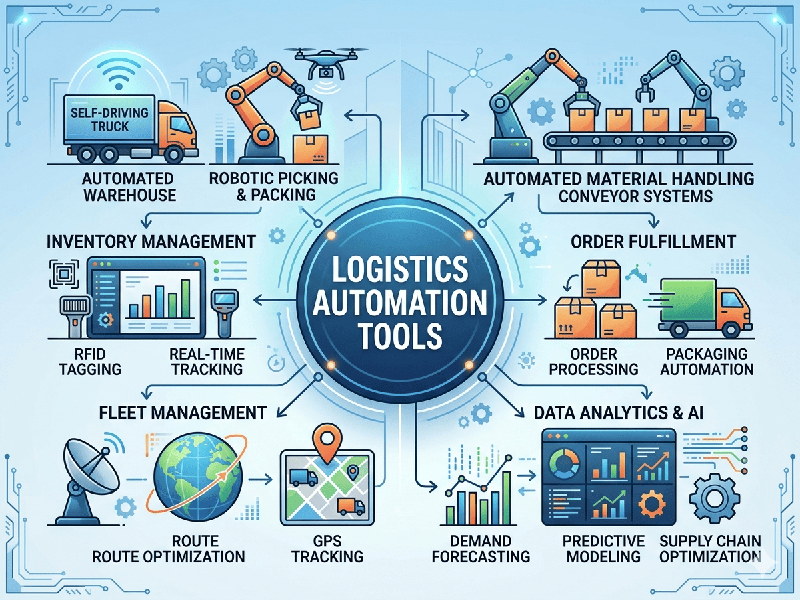
Logistics Automation Tools
Logistics automation has moved beyond basic tracking to Autonomous
Orchestration. The goal is no longer just "moving boxes," but
creating a self-correcting supply chain that uses AI to predict disruptions
before they happen.
1. Warehouse Automation (WMS & Robotics)
Modern warehouses use a mix of "brains" (software)
and "brawn" (robotics) to handle surging e-commerce volumes.
- AI-Driven WMS: Platforms like Manhattan
Associates and Oracle Logistics Cloud now use machine learning
for "Intelligent Slotting"—automatically moving high-velocity
items closer to packing stations based on predicted demand.
- Autonomous Mobile Robots (AMRs): Unlike older robots that follow
fixed paths, AMRs from companies like Locus Robotics or GreyOrange
use LiDAR to navigate dynamically around human workers.
- Computer Vision: Used for "Zero-Touch"
quality control. Systems scan items at high speed to detect damaged
packaging or incorrect labels without a human needing to touch the box.
2. Transportation Management Systems (TMS)
A TMS acts as the "control tower" for moving goods
between facilities.
- Predictive ETAs: Tools like project44 and
FourKites provide real-time visibility. In 2026, they don't just
show a GPS dot; they calculate "Risk-Adjusted ETAs" by factoring
in port congestion, weather patterns, and even driver fatigue.
- Automated Carrier Selection: AI-enhanced engines (e.g., Blue
Yonder) automatically tender loads to the best carrier based on
historical performance and current market rates, rather than just the
lowest bidder.
- Freight Audit Automation: Tools like Transporeon
use AI to spot "rate creep" and billing anomalies in thousands
of invoices that traditional rule-based systems might miss.
3. Last-Mile Delivery Tools
This is the most expensive part of the journey, where
automation is focused on density and customer experience.
- Route Optimization: Tools like Shipsy and LogiNext
solve the "Traveling Salesman Problem" in real-time, re-routing
drivers instantly if a customer cancels or a new "on-demand"
order comes in.
- NDR Automation: "Non-Delivery Report"
automation (common in FarEye) uses AI to instantly contact a
customer via WhatsApp/SMS if a delivery fails, attempting to re-schedule
or get better directions while the driver is still in the vicinity.
- Electronic Proof of Delivery
(ePOD): Beyond
signatures, modern tools capture geo-coordinates, photos, and time-stamps
to eliminate "where is my order" disputes.
4. Supply Chain Orchestration (Low-Code/No-Code)
For businesses that need to connect multiple
"silos" (like a Shopify store to a 3PL), these tools act as the glue:
5. Key Metrics for Automation Success
If you are implementing these tools, track these three
"North Star" metrics:
1.
On-Time In-Full (OTIF): The % of orders that arrive exactly when promised with all
items present.
2.
Cost per Order:
Total logistics spend divided by order volume (automation should drive this
down by 15–30%).
3.
Order-to-Cash Cycle: How fast can you turn an order into realized revenue through automated
invoicing.